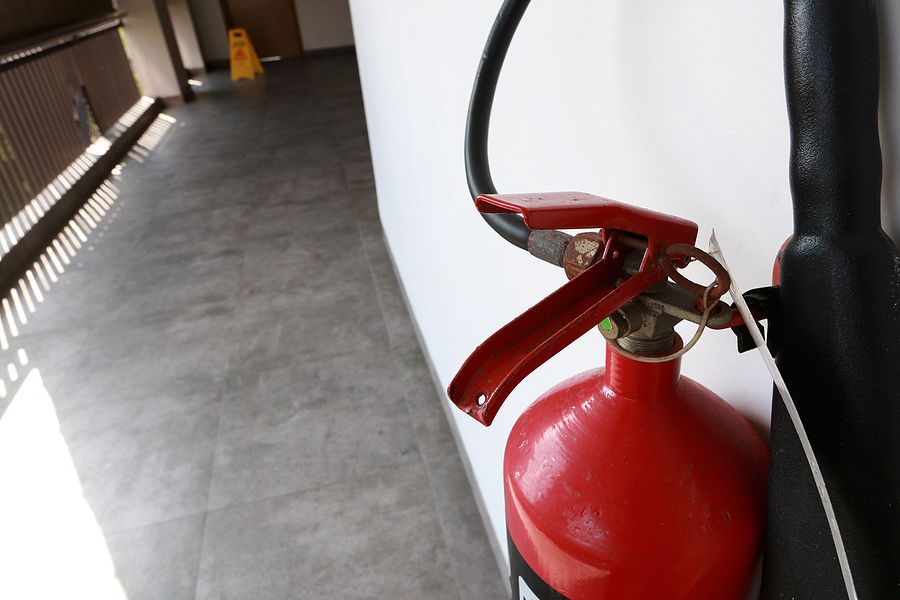
Fire extinguisher placement guidelines for commercial buildings. Learn about distance, mounting height, visibility, and inspection requirements.
Fire extinguishers are some of the most common pieces of fire protection equipment inspected during commercial fire inspections—and some of the most cited. While you may know that fire extinguishers are required on your property, failing an inspection because they aren’t mounted correctly or are obstructed may come as a surprise.
Placement is crucial when it comes to fire extinguishers. Not only do you need to pass inspections, but you also need to ensure occupants are able to access them during the crucial initial moments of a fire. We review the commercial fire extinguisher placement requirements you need to know about below.
Fire Extinguisher Placement Requirements: The Codes
NFPA 10: Standard for Portable Fire Extinguishers is the benchmark set of rules that govern commercial fire extinguisher placement. State and local fire authorities use NFPA 10 as a base standard and adopt it into their fire codes.
OSHA also defers to NFPA 10 as a guideline for fire extinguisher placement requirements in the workplace.
While your local Authority Having Jurisdiction (AHJ) may have different requirements, the baseline placement rules enforced by fire inspectors during commercial fire extinguisher inspections can be found in NFPA 10.
Fire Extinguisher Travel Distance Requirements
Travel distance is one of the most common placement violations. Components of occupancy, hazard level, and intended use determine maximum travel distance to the nearest fire extinguisher.
General requirements include:
- Office buildings and other Class A fire hazards: 75 feet
- Class B fire hazards*: 30-50 feet, depending on severity
- Commercial Kitchen (Class K): Within 30 feet of cooking equipment
- *Class B hazards include rooms or facilities where flammable liquids are manufactured or stored.
NFPA 10 also dictates that fire extinguishers be spaced out in accordance with total floor area. While this can vary, a good rule of thumb is that one fire extinguisher can cover up to 3,000 square feet of space for Class A hazards. Once again, this may be adjusted based on occupancy and fire hazard classification.
Usable space can also impact spacing—and is commonly cited by fire inspectors. Storage rooms, mechanical closets, and dead-end corridors require special consideration for proper fire extinguisher spacing.
Mounting Height and Installation
Incorrect mounting height is another fire extinguisher placement violation commonly cited by fire inspectors.
Fire extinguishers must be installed no more than 5 feet above the floor—measured from the ground to the top of the unit. The bottom of the fire extinguisher cannot be less than 4 inches off the ground. If a fire extinguisher weighs in at more than 40 pounds, the maximum mounting height is lowered to 3.5 feet.
Regardless of the fire extinguisher’s weight, mounting solutions must also be approved to hold the weight of that fire extinguisher. Fire extinguishers cannot be secured with makeshift methods.
Need visibility and access. Equipment, furniture, decorations, or stored items should not block or hide a fire extinguisher from view. Fire extinguishers must also be easily accessed in the event of an emergency. During inspections, fire extinguishers are considered blocked if furniture, equipment, or stored items must be moved to access the equipment.
Occupancy Type Matters
Different types of occupancies have different placement considerations.
Think about how people interact with space:
- Is your inventory frequently moved or shuffled, potentially blocking your fire extinguishers? (Warehouses)
- Could rearranging your office space affect travel distances or block extinguishers? (Office spaces)
- Does your cooking equipment prevent your Class K fire extinguishers from being correctly placed? (Restaurants)
Placement should be assessed regularly to remain compliant, especially if your operation changes.
Fire Extinguisher Placement: Frequently Cited Violations
Here are the most common fire extinguisher placement violations we find during commercial fire inspections:
- Fire extinguishers mounted too high or too low
- Blocked or hidden fire extinguishers
- Exceeding travel distances
- Incorrect type of fire extinguisher for specific hazards
- Fire extinguishers placed too close to hazards
- Missing or illegible signage
These placement violations often happen when other fire safety issues are found during fire alarm inspections, fire sprinkler inspections, or fire suppression system inspections.
Fire extinguisher placement is only one part of inspection and documentation requirements. Fire extinguishers must also be inspected monthly and annually to remain compliant. Fire extinguishers that have missing or incomplete documentation can be cited as non-compliant even if they’re correctly placed.
Documentation often gets overlooked when thinking about fire extinguisher placement, but fire extinguishers are one part of your fire system that should be inspected regularly.
Placement is Just One Part of Fire Safety
Fire extinguishers are only effective when they are properly placed, accessible, and maintained. Fire extinguisher placement should be determined by your:
- Building floor plan
- Occupant travel paths
- Fire alarm system coverage
- Fire sprinkler and fire suppression system arrangements
As your building’s fire risk changes, your fire extinguisher placement may need adjustment. What was compliant ten years ago may not be by today’s standards. If your building has gone through renovations, your placement should be reevaluated to ensure it still complies with current fire codes.
Professional Fire Inspections Help
Since many fire extinguisher placement violations are preventable, fire inspections help identify these issues. Fire extinguisher placement should be reviewed by a fire protection professional to ensure compliance with your local fire code.
Fire protection experts, such as Brazas Fire, can help you understand how fire extinguisher placement works within your fire and life safety system. Contact us online or call (505) 889-8999 if you have questions about whether your fire extinguishers are placed correctly to meet fire extinguisher placement requirements. We can provide a review as part of your annual fire system inspection.