
Professional commercial kitchen hood cleaning involves much more than cleaning the visible stainless-steel canopy above the cooking equipment. A complete kitchen exhaust cleaning service may include cleaning the hood interior, removing grease from accessible exhaust ductwork, cleaning the rooftop exhaust fan, and removing accumulated grease from accessible portions of the exhaust pathway. Brazas Fire’s documented kitchen exhaust services include complete hood cleaning, exhaust duct cleaning, fan cleaning, grease removal, and scheduled maintenance.
That distinction is important for restaurant owners and commercial kitchen managers in Albuquerque. A hood may look relatively clean from the cooking line while grease is accumulating inside areas employees rarely see, including the ductwork and rooftop exhaust fan.
Professional commercial kitchen hood cleaning is therefore better understood as exhaust-system cleaning—not simply surface cleaning.
The basic pathway looks like this:
Cooking equipment → Hood → Grease-removal components → Exhaust ductwork → Rooftop exhaust fan → Discharge area
Grease-laden vapors produced during cooking travel through this pathway. That is why professional cleaning needs to address more than the portion of the system visible from the kitchen.
Brazas Fire provides commercial kitchen hood cleaning, restaurant exhaust-system cleaning, and rooftop exhaust-fan cleaning as part of its commercial fire-protection services throughout Albuquerque and New Mexico.
What Does Professional Commercial Kitchen Hood Cleaning Include?
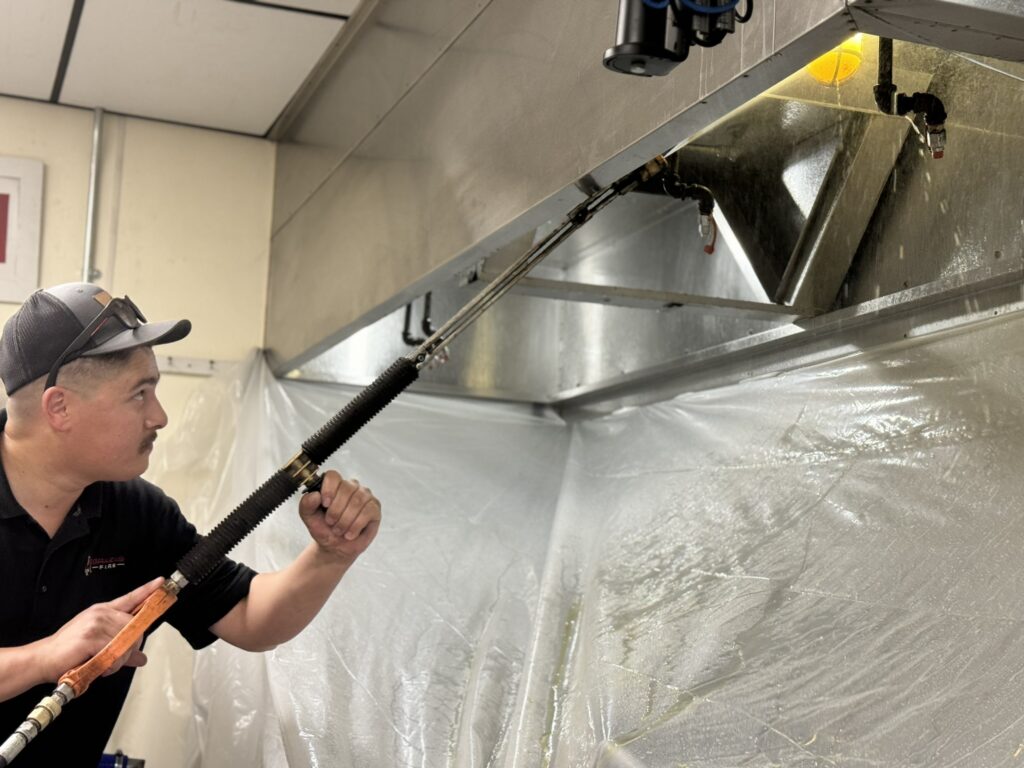
The exact scope depends on the exhaust system and the service being contracted. A professional quote should clearly identify which components are included.
For Brazas Fire, documented kitchen exhaust cleaning services include:
Exhaust Component | Cleaning Purpose |
Hood / canopy | Remove accumulated grease from interior surfaces |
Accessible exhaust ductwork | Remove grease deposits inside the exhaust pathway |
Rooftop exhaust fan | Remove accumulated grease from accessible fan areas |
Fan components and housing | Address accessible grease accumulation around the fan |
Accessible exhaust areas | Remove grease deposits throughout serviceable portions of the system |
Grease accumulation | Remove buildup rather than simply cleaning visible surfaces |
Scheduled maintenance | Help keep the exhaust system on an appropriate cleaning schedule |
Brazas Fire specifically lists complete hood cleaning, exhaust duct cleaning, fan cleaning, grease removal, NFPA 96-compliant cleaning, and scheduled maintenance as part of its Kitchen Exhaust Hood Cleaning services.
Let’s look at the major areas individually.
Is the Inside of the Commercial Kitchen Hood Cleaned?

Yes. The hood interior is a fundamental part of professional hood cleaning.
During cooking, grease-laden vapors rise from fryers, ranges, charbroilers, grills, and other commercial cooking equipment. The hood captures these vapors so the exhaust system can move them away from the cooking area.
Over time, grease can accumulate on interior hood surfaces.
Cleaning these surfaces helps remove the deposits produced through normal commercial cooking operations.
This is different from simply wiping the outside of a stainless-steel hood.
The exterior may be the most visible part of the system, but appearance alone does not tell you how much grease has accumulated farther inside the exhaust pathway.
Does Commercial Hood Cleaning Include the Ductwork?
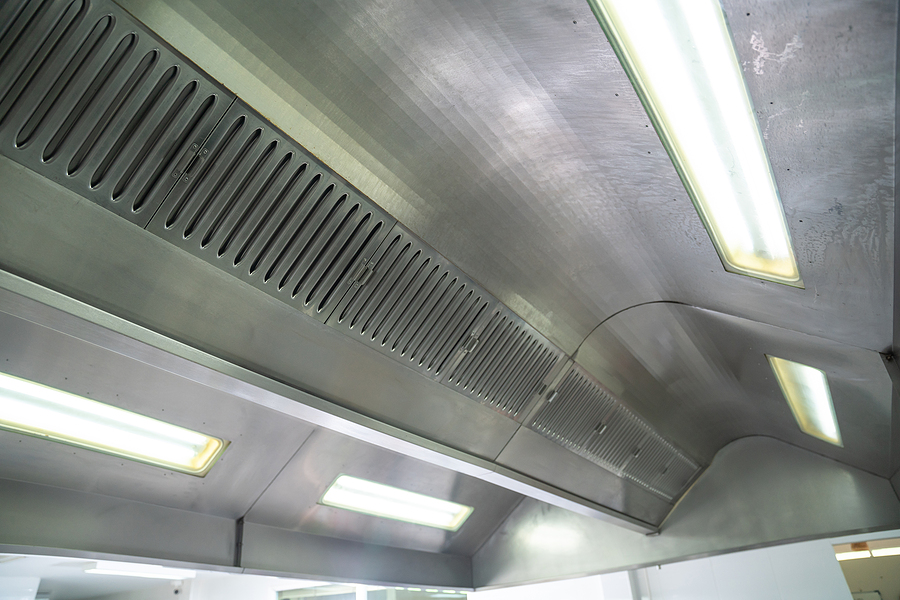
Professional commercial exhaust cleaning can include the ductwork, and Brazas Fire specifically lists exhaust duct cleaning as part of its kitchen exhaust hood cleaning services.
This is one of the most important distinctions between professional exhaust cleaning and routine restaurant housekeeping.
The duct is the pathway that carries exhaust from the hood toward the rooftop fan and discharge area. Grease can accumulate inside these hidden areas where restaurant employees cannot easily see it during normal operations.
The amount and configuration of ductwork vary considerably from one building to another.
A restaurant might have:
- A relatively short exhaust run
- Long horizontal ductwork
- Vertical ductwork extending to the roof
- Multiple turns in the exhaust pathway
- Several access points
- More than one hood and exhaust system
Access matters because technicians need to be able to reach serviceable portions of the system.
The article-production worksheet specifically emphasizes that grease can accumulate in ductwork outside the restaurant staff’s normal field of view.
That is one reason cleaning only the visible canopy should not be confused with professional exhaust-system cleaning.
Does Hood Cleaning Include the Rooftop Exhaust Fan?

For Brazas Fire, fan cleaning is specifically included among its documented kitchen exhaust cleaning services, and rooftop exhaust-fan cleaning is identified as a primary company service.
The exhaust fan is responsible for drawing cooking exhaust through the system and discharging it outside the building.
Because grease-laden air moves toward the fan, grease can accumulate on and around accessible fan components.
Brazas Fire’s company knowledge base identifies fan grease accumulation and roof contamination among common problems encountered by restaurants.
The condition and accessibility of the fan therefore matter during professional cleaning.
Why Exhaust Fan Access Matters

A rooftop fan needs appropriate access so technicians can service areas beneath and around it.
Brazas Fire also installs UL-approved exhaust fan hinge kits that allow rooftop exhaust fans to be safely opened during required cleaning.
A hinge kit does not clean the system by itself. Its purpose is to improve access to the fan and associated exhaust components during service.
For restaurants with difficult-to-access fans, improving access can be an important part of maintaining the exhaust system.
What About Grease Around the Rooftop Exhaust Fan?
Grease does not necessarily stop at the duct.
Accumulation around rooftop exhaust equipment can contribute to contamination of the surrounding roof area.
Brazas Fire addresses this through two related services:
Exhaust fan cleaning helps remove grease from the fan and accessible associated areas.
Grease containment systems are designed to help prevent grease runoff and resulting roof damage. Brazas Fire installs and maintains rooftop grease-containment systems for this purpose.
These are related services, but they are not the same thing.
A grease-containment system does not replace professional exhaust cleaning, and exhaust cleaning does not eliminate the usefulness of properly designed grease containment where it is needed.
What Happens During Professional Restaurant Hood Cleaning?
Every exhaust system is different, so the precise procedure and equipment used can vary.
Brazas Fire’s general company service workflow begins with customer contact and site evaluation and proceeds through estimating, scheduling, service, documentation, customer education, and ongoing maintenance scheduling.
For educational purposes, professional commercial hood cleaning can be understood as a process involving several basic stages.
1. Evaluate the Exhaust System
Before cleaning begins, the system needs to be understood.
That can include evaluating the:
- Hood configuration
- Ductwork
- Exhaust fan
- Accessible areas
- Grease accumulation
- Roof access
- General condition of the system
A small café with a single hood may present a very different cleaning project from a large commercial kitchen with several cooking lines and multiple exhaust systems.
2. Prepare the Work Area
Professional hood cleaning involves grease removal, so the surrounding work area needs appropriate preparation.
This helps protect kitchen surfaces and equipment in the immediate service area as appropriate to the job.
3. Access the Exhaust Components
Cleaning cannot be effective in areas that cannot be properly reached.
Depending on the system, technicians may need access to the hood, ductwork, rooftop fan, and other serviceable portions of the exhaust pathway.
This is why appropriate duct access and rooftop fan access are important considerations.
4. Clean the Hood Interior
Accumulated grease is removed from appropriate interior hood surfaces.
This addresses the portion of the exhaust system directly above the commercial cooking equipment.
5. Clean Accessible Exhaust Ductwork
The cleaning process continues into accessible portions of the exhaust ductwork.
This is critical because grease deposits inside a duct may be invisible to employees standing underneath the hood.
6. Clean the Rooftop Exhaust Fan
Accessible grease accumulation is addressed at the exhaust fan.
Depending on the fan configuration, appropriate access may be necessary to reach areas beneath and around the fan.
7. Remove Accumulated Grease
The objective is not simply to make the stainless steel look better.
Professional exhaust cleaning is focused on grease removal throughout the serviceable portions of the exhaust pathway.
8. Complete Final Cleanup and Documentation
The service area is addressed after the exhaust cleaning is completed, and applicable service documentation can be provided as part of professional maintenance.
Documentation is an important part of Brazas Fire’s overall approach to commercial fire protection. The company’s editorial standards identify dependable documentation and communication among the priorities of its ideal commercial customers.
What Is the Difference Between Employee Cleaning and Professional Hood Cleaning?
This is where many restaurant owners can understandably become confused.
Restaurant employees have an important role in keeping the kitchen clean.
But routine housekeeping and professional kitchen exhaust cleaning are not interchangeable.
Routine Restaurant Cleaning | Professional Exhaust Cleaning |
Visible hood surfaces | Hood interior |
Accessible stainless steel | Exhaust-system components |
Routine surface grease | Accumulated exhaust-system grease |
Daily or regular housekeeping | Periodic professional service |
Easily accessible kitchen areas | Accessible ductwork and exhaust fan |
General cleanliness | Exhaust-system grease removal |
The Universal Article Variables Worksheet specifically calls for this distinction because it addresses a common misconception about what commercial hood cleaning actually means.
Restaurant employees should continue cleaning appropriate accessible surfaces as part of routine kitchen sanitation and housekeeping.
That work, however, does not replace professional servicing of portions of the exhaust system that are inaccessible during ordinary kitchen cleaning.
Why Is Grease Removal So Important?
A commercial kitchen hood does not exist merely to remove cooking odors.
It is part of an exhaust system handling air that can contain grease produced by commercial cooking.
Brazas Fire’s company materials identify grease buildup inside kitchen hoods and ducts and dirty rooftop exhaust fans as common restaurant concerns.
That means the condition of the system cannot always be evaluated by looking at the hood from below.
Grease may be present farther along the exhaust pathway.
Professional cleaning helps remove those grease deposits and supports proper commercial kitchen fire protection and maintenance.
It should not, however, be described as eliminating every possibility of a kitchen fire. Hood cleaning is one component of a larger restaurant fire-safety program.
Is Hood Cleaning the Same as a Fire Suppression Inspection?
No. Commercial kitchen hood cleaning and kitchen hood fire suppression inspection are separate services.
This distinction is important.
Brazas Fire separates the two services in its company knowledge base.
Its Kitchen Hood Fire Suppression services include:
- Installation
- Inspection
- Semiannual testing
- System recharge
- Repairs
- New restaurant installations
- Kitchen remodel upgrades
- Food truck suppression systems
Its Kitchen Exhaust Hood Cleaning services separately include:
- Complete hood cleaning
- Exhaust duct cleaning
- Fan cleaning
- Grease removal
- Scheduled maintenance.
The services work together as parts of commercial kitchen fire protection, but one should not be substituted for the other.
Hood cleaning removes accumulated grease from exhaust-system components.
Hood suppression inspection and testing address the fire-suppression system designed to respond to applicable cooking fires.
A restaurant may need both services on appropriate schedules.
Is Hood Cleaning the Same as Fire Extinguisher Service?
No.
Portable fire extinguishers provide another separate layer of fire protection.
Brazas Fire sells and services commercial fire extinguishers in addition to providing kitchen hood suppression and commercial exhaust-cleaning services.
This is useful for restaurant owners to understand because a complete fire-safety program can involve several separate systems and maintenance responsibilities.
Service | Primary Purpose |
Commercial hood cleaning | Remove grease from exhaust-system components |
Hood suppression inspection | Inspect and maintain fire-suppression equipment |
Fire extinguisher service | Maintain portable fire extinguishers |
Grease containment | Help control rooftop grease runoff |
Routine kitchen cleaning | Clean accessible kitchen and food-preparation surfaces |
No single service replaces all of the others.
What Should You Ask a Commercial Hood-Cleaning Company?
Before choosing a provider, restaurant owners should understand exactly what the quoted service includes.
Useful questions include:
Does the service include the hood interior?
Does it include accessible exhaust ductwork?
Does it include the rooftop exhaust fan?
How will difficult-to-access portions of the system be addressed?
What happens if heavy grease accumulation is discovered?
What service documentation will I receive?
How frequently should my particular exhaust system be evaluated and cleaned?
Are hood suppression inspection and hood cleaning separate services?
These questions are especially useful when comparing bids.
A lower price may not necessarily represent better value if two companies are quoting significantly different scopes of work.
Brazas Fire’s pricing philosophy emphasizes honest pricing, code-compliant work, long-term reliability, preventative maintenance, and value over shortcuts.
How Often Should Professional Commercial Hood Cleaning Be Done?
There is not one cleaning interval that appropriately describes every commercial kitchen.
A restaurant’s needs can depend on factors such as its cooking operation, cooking volume, grease production, and the condition of the exhaust system.
A high-volume commercial kitchen can place very different demands on an exhaust system than a lower-volume operation.
That is why how often commercial kitchen hoods should be cleaned is a separate question from what the cleaning service includes.
Brazas Fire recommends regular kitchen exhaust cleaning as part of commercial kitchen maintenance.
Restaurant operators should use an appropriate cleaning and inspection schedule rather than waiting until grease accumulation becomes obvious from the cooking line.
How Much Does Professional Commercial Kitchen Hood Cleaning Cost?
The cost depends on the actual system and service requirements.
Factors can include:
- Number and size of hoods
- Length and configuration of ductwork
- Number of rooftop exhaust fans
- Grease accumulation
- Accessibility
- Cleaning history
- System configuration
- Scope of the contracted service
That is why restaurant owners comparing commercial kitchen hood cleaning costs in Albuquerque should compare what each contractor includes—not simply the number at the bottom of the estimate.
A quote for cleaning only a limited portion of a system is not necessarily comparable to a quote covering the hood, accessible ductwork, exhaust fan, and grease removal.
What Role Does NFPA 96 Play in Commercial Hood Cleaning?
Brazas Fire’s company knowledge base identifies NFPA 96 – Ventilation Control and Fire Protection of Commercial Cooking Operations as an authoritative resource relevant to commercial kitchen exhaust and fire protection.
For restaurant owners, the important practical point is that commercial cooking exhaust maintenance involves more than cosmetic cleanliness.
Professional exhaust cleaning helps remove grease deposits and supports proper commercial kitchen fire protection and maintenance.
At the same time, restaurant owners should avoid treating phrases such as “NFPA compliant” as though they mean that one cleaning service automatically satisfies every fire-protection responsibility for a commercial kitchen.
Exhaust cleaning, suppression-system maintenance, portable extinguishers, appropriate inspections, documentation, employee practices, and other fire-protection responsibilities are separate but related parts of maintaining a commercial kitchen.
Why Professional Hood Cleaning Matters for Albuquerque Restaurants
Albuquerque has everything from small cafés and food trucks to institutional kitchens, hotels, high-volume restaurants, and multi-location food-service operations.
Their exhaust systems can be very different.
What they have in common is that grease accumulation can occur in places that are not obvious during normal kitchen operations.
Brazas Fire’s editorial standards specifically identify practical understanding of commercial cooking hazards, grease fires, commercial kitchen exhaust systems, hood and duct cleaning, rooftop exhaust fans, grease containment, and exhaust fan hinge kits as areas that company content should demonstrate.
Professional cleaning provides a way to address the exhaust pathway rather than concentrating only on the parts of the kitchen employees can see.
Frequently Asked Questions About Professional Commercial Hood Cleaning
What Is Included in Professional Commercial Kitchen Hood Cleaning?
Professional commercial kitchen hood cleaning can include cleaning the hood interior, removing grease from accessible exhaust ductwork, cleaning the rooftop exhaust fan, and addressing accumulated grease throughout serviceable portions of the exhaust system. Brazas Fire specifically provides complete hood cleaning, exhaust duct cleaning, fan cleaning, grease removal, and scheduled maintenance.
Does Commercial Hood Cleaning Include the Ductwork?
Service scope can vary by contractor, so restaurant owners should confirm what their quote includes. Brazas Fire specifically lists exhaust duct cleaning as part of its kitchen exhaust hood cleaning services.
Does Commercial Hood Cleaning Include the Rooftop Exhaust Fan?
Brazas Fire includes fan cleaning among its kitchen exhaust services and separately identifies rooftop exhaust-fan cleaning as a primary commercial service.
Why Does the Rooftop Fan Need to Be Accessible?
Proper access allows technicians to reach areas of the fan and exhaust system requiring cleaning. Brazas Fire installs UL-approved hinge kits that allow rooftop exhaust fans to be safely opened during required cleanings.
Can Restaurant Employees Clean Their Own Hood?
Employees can and should perform appropriate routine cleaning of accessible kitchen and hood surfaces. That routine housekeeping does not replace professional cleaning of ductwork, exhaust fans, and other portions of the exhaust system that employees normally cannot access.
Does Hood Cleaning Include Fire Suppression Inspection?
Not automatically. They are separate services. Brazas Fire provides both kitchen exhaust hood cleaning and kitchen hood fire-suppression inspection, testing, maintenance, and repair.
What Is the Difference Between Hood Cleaning and Grease Containment?
Hood cleaning removes accumulated grease from serviceable exhaust-system components. A rooftop grease-containment system helps prevent grease runoff and roof damage. Brazas Fire provides both services.
How Do I Know What My Hood-Cleaning Quote Includes?
Ask the contractor to identify which components are included, particularly the hood interior, accessible ductwork, exhaust fan, grease removal, and any service documentation. Do not assume every company defines “hood cleaning” exactly the same way.
Schedule Professional Commercial Kitchen Hood Cleaning in Albuquerque
The most important thing to remember is simple:
Professional hood cleaning should go beyond making the visible stainless steel look clean.
Grease-laden exhaust moves from the cooking area into the hood, through ductwork, toward the exhaust fan, and ultimately to the discharge area. Professional exhaust cleaning addresses grease accumulation within accessible portions of that pathway.
Brazas Fire provides complete hood cleaning, exhaust duct cleaning, fan cleaning, grease removal, and scheduled maintenance for commercial kitchens.
The company is based in Albuquerque and serves restaurants, food trucks, schools, healthcare facilities, government buildings, industrial facilities, and other commercial customers throughout New Mexico. Brazas Fire also identifies itself as a Phil Ackland Qualified Company for commercial kitchen hood cleaning.
Its internal linking strategy specifically positions kitchen hood cleaning alongside related services such as hood fire suppression, grease containment, exhaust fan hinge kits, and NFPA 96 information, creating a broader restaurant fire-safety resource for New Mexico businesses.
If you need professional commercial kitchen hood cleaning for an Albuquerque restaurant or commercial kitchen, call Brazas Fire at 505-889-8999 to schedule service or request a quote.