Restaurant owners often notice small metal links suspended inside their kitchen hood and wonder what they do. A fusible link may look simple, but they are an important part of many commercial kitchen fire suppression systems.
These components are called fusible links. Their job is to respond to dangerous heat and help activate the kitchen hood fire suppression system automatically when conditions indicate that a cooking fire may be developing.
In plain language, a fusible link acts like a heat-sensitive trigger.
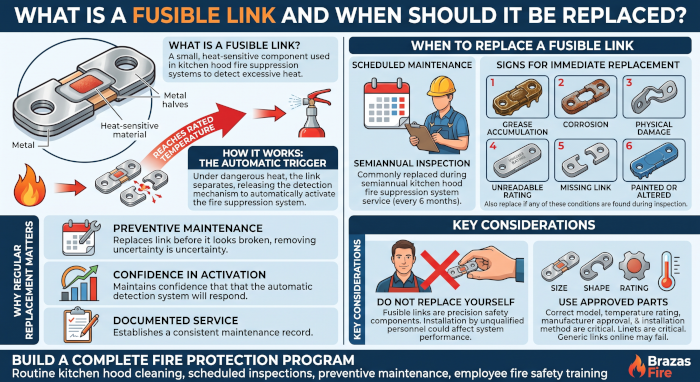
Under normal kitchen conditions, it remains intact and holds part of the detection mechanism in place. If the temperature around the link reaches its designed activation point, the link separates. That releases the detection cable or mechanism connected to the suppression system, allowing the system to discharge wet chemical agent over the protected cooking equipment.
Because fusible links play such an important role in automatic fire detection, they should not be treated as ordinary pieces of metal. They are precision safety components selected for a specific system, temperature rating, and installation location.
The Brazas Fire publishing standards emphasize explaining technical fire protection components in plain language, showing why they matter, and helping business owners make informed maintenance decisions.
The Direct Answer on What is Fusible Link
A fusible link is a heat-sensitive component used in many mechanical kitchen hood fire suppression systems to detect excessive heat and initiate automatic system activation.
When exposed to its rated temperature, the link is designed to separate. This movement releases the system’s detection mechanism, which then activates the suppression system.
As for replacement, fusible links are commonly replaced during the required semiannual kitchen hood fire suppression system service, unless the manufacturer’s instructions, system condition, or applicable requirements call for earlier replacement.
They may also need to be replaced sooner if technicians find:
- Grease accumulation
- Corrosion
- Physical damage
- An unreadable or incorrect temperature rating
- A missing or improperly installed link
- Evidence that the link has been painted, altered, or contaminated
- An unknown maintenance history
The exact replacement requirements can depend on the system manufacturer, the approved design, applicable fire protection standards, and the local Authority Having Jurisdiction, commonly called the AHJ.
What Is a Fusible Link?
A fusible link is usually made from two small metal sections joined by a heat-sensitive material. The link is manufactured to remain secure under normal operating temperatures but separate when exposed to a specific level of heat.
Fusible links are installed within the detection line of a kitchen hood fire suppression system. Depending on the system design, several links may be positioned inside the hood, plenum, or other protected areas where rising heat from a fire would reach them.
Each link carries a temperature rating selected for its location.
This matters because commercial kitchens normally produce substantial heat. Fryers, charbroilers, ranges, ovens, and griddles can create high temperatures during ordinary cooking. The fusible link must be rated high enough to remain intact during normal operations while still responding when abnormal heat conditions develop.
That is one reason restaurant owners should never replace a link with one that merely looks similar. The correct temperature rating, model, manufacturer approval, and installation method all matter.
How Does a Fusible Link Detect a Fire?
A fusible link does not detect smoke, flame color, or grease directly. It responds to heat.
During normal cooking, the link remains intact and keeps tension on the system’s detection cable or mechanical linkage. If a fire produces enough sustained heat near the link, the heat-sensitive connection reaches its rated temperature and separates.
The general sequence works like this:
- A cooking fire produces rapidly rising heat.
- Heat reaches the fusible link installed in the detection area.
- The link separates at its rated temperature.
- The detection cable or mechanism is released.
- The suppression system activates.
- Wet chemical agent discharges over the protected appliances.
- Gas and, where applicable, electrical power are shut off through the system interlocks.
This automatic response is valuable because it does not depend on an employee seeing the fire and reaching the manual pull station in time.
The manual pull station remains an important secondary method of activation, but the fusible-link detection system is designed to react automatically when dangerous heat reaches the proper point.
Why Fusible Links Are Essential to Automatic Activation
A kitchen hood fire suppression system must be able to respond quickly when a fire occurs. Grease and cooking-oil fires can intensify rapidly, particularly when appliances continue supplying heat.
Fusible links help provide that automatic response.
Without a functioning detection mechanism, the system may not activate automatically when dangerous heat develops. Employees could still use the manual pull station, but relying only on human recognition and reaction would remove an important layer of protection.
Fusible links are especially important because commercial kitchens are busy environments. Staff may be working in different areas, noise levels may be high, and smoke or flame may not be immediately visible from every position.
The automatic detection system continues monitoring heat conditions while the kitchen is operating.
Although fusible links are small, their role is significant. They help connect the moment abnormal heat develops with the coordinated response of the kitchen hood fire suppression system.
That response may include:
- Wet chemical discharge
- Gas shutoff
- Electrical disconnects where applicable
- Alarm or monitoring functions, depending on system design
- Interruption of the heat source feeding the fire
Why Fusible Links Require Regular Replacement
Fusible links are designed to remain dependable while exposed to the demanding conditions found inside a commercial kitchen hood. Those conditions may include heat, grease-laden vapors, moisture, cleaning chemicals, smoke, and continuous airflow from the exhaust system.
Even though a fusible link may appear unchanged from the outside, it is not intended to remain in service indefinitely.
In many kitchen hood fire suppression systems, fusible links are commonly replaced during the system’s semiannual inspection and maintenance service. The exact schedule should follow the suppression system manufacturer’s instructions, the approved system design, applicable fire protection standards, and any requirements established by the local Authority Having Jurisdiction, or AHJ.
Regular replacement helps maintain confidence that the automatic detection system will respond as designed. It also gives the service technician an opportunity to verify that the correct link is installed in the correct location and that the detection assembly remains properly tensioned, routed, and secured.
The important point for restaurant owners is that replacement is preventive maintenance. The link does not need to look broken before it receives attention.
How Grease Buildup Can Affect a Fusible Link
Grease accumulation is one of the most common conditions technicians encounter inside commercial kitchen hoods.
As cooking vapors move upward into the exhaust system, grease can collect on:
- Fusible links
- Detection cable
- Link holders
- Pulleys and corner assemblies
- Discharge nozzles
- Hood and plenum surfaces
A heavily coated fusible link can become difficult to inspect. Grease may hide corrosion, damage, identifying markings, or the link’s temperature rating. Accumulation can also affect the surrounding mechanical components that must move freely when the link separates.
Grease should never be scraped, bent, twisted, or aggressively cleaned from a fusible link by restaurant employees. The component may look simple, but handling it incorrectly could damage the link or disturb the detection mechanism.
Proper kitchen hood cleaning helps control accumulation around the detection system. However, hood cleaners should also avoid moving, painting, covering, or altering suppression components during the cleaning process.
The fire suppression system and exhaust-cleaning program should work together. Cleaning reduces grease hazards, while professional suppression-system maintenance verifies that the detection and discharge components remain ready for service.
Corrosion, Moisture, and Physical Damage
Commercial kitchens generate moisture as well as heat and grease. Steam, condensation, cleaning solutions, and airborne contaminants can contribute to corrosion over time.
Corrosion matters because a fusible link depends on its manufactured construction and heat-sensitive connection. Rust, pitting, discoloration, or deterioration may indicate that the link should be replaced.
Physical damage is another concern. During cleaning, equipment movement, or kitchen renovations, links and their supporting hardware can be:
- Bent
- Twisted
- Painted
- Knocked out of position
- Installed backward
- Replaced with an incorrect part
- Removed and not properly reinstalled
A damaged or altered fusible link should not be straightened and reused by restaurant staff. It should be evaluated by a qualified fire protection technician.
Age is also part of the maintenance decision. A link may appear clean but still have an unknown installation date or service history. Regular documented replacement removes that uncertainty and helps establish a consistent maintenance record.
Why Manufacturer-Approved Replacement Parts Matter
Not all fusible links are interchangeable.
Links may differ by:
- Temperature rating
- Size
- Shape
- Load capacity
- Connection method
- Manufacturer
- Intended system application
Two links may look nearly identical but be designed to operate under different conditions.
Installing a link with the wrong temperature rating could create serious performance concerns. A rating that is too low for the location could contribute to an unwanted activation during normal high-temperature cooking. A rating that is too high may not respond at the point intended by the approved system design.
The replacement link should match the system manufacturer’s specifications and the temperature rating required for that exact location. Qualified technicians use system documentation, manufacturer information, and the approved design to select the proper component.
Restaurant owners should avoid purchasing generic links online or replacing them based only on appearance. Kitchen hood fire suppression systems are coordinated life-safety systems, and even a small replacement part can affect how the system operates.
What Technicians Inspect During Fusible Link Service
During a professional kitchen hood fire suppression inspection, the technician evaluates more than the link itself.
Depending on the system design and manufacturer requirements, the inspection may include checking:
- Fusible link condition and temperature rating
- Link placement within the detection area
- Detection cable condition
- Cable tension
- Pulleys, brackets, and corner assemblies
- Releasing mechanism operation
- Manual pull station condition
- Discharge-nozzle positioning
- Gas and electrical interlocks
- Evidence of grease buildup or unauthorized modifications
Fusible links are typically removed and replaced as part of the required maintenance procedure. The technician then confirms that the detection system is properly assembled and capable of operating as intended.
This is one reason professional service is essential. Replacing the link without understanding the entire mechanical detection system could leave improper cable tension, damaged hardware, or another deficiency unnoticed.
Common Misconceptions About Fusible Links
“The link is clean, so it does not need to be replaced.”
Appearance alone does not determine whether a fusible link should remain in service. Replacement intervals are based on manufacturer instructions and applicable maintenance requirements, not only visible condition.
“Any link with the same shape will work.”
Links that look alike may have different temperature ratings or system approvals. The correct manufacturer-approved component should always be used.
“The link senses smoke.”
A fusible link responds to heat, not smoke. It separates when its rated temperature is reached.
“Employees can replace it during daily cleaning.”
Fusible links are part of the fire suppression system’s automatic detection mechanism. Replacement should be performed by qualified personnel who can inspect and reset the complete assembly correctly.
“Grease on the link makes it activate immediately.”
Grease contamination is a maintenance concern, but it does not automatically mean the link will activate. The condition should be professionally evaluated because buildup can hide damage and affect nearby mechanical components.
How NFPA 17A and NFPA 96 Relate to Fusible Links
NFPA 17A addresses wet chemical extinguishing systems, including their inspection, testing, maintenance, and detection components. For restaurant owners, its practical purpose is to help ensure that the suppression system remains capable of detecting and controlling a commercial cooking fire.
NFPA 96 addresses ventilation control and fire protection for commercial cooking operations. It helps connect hood cleanliness, grease control, equipment arrangement, and fire suppression into one broader kitchen-safety program.
These standards should be understood as nationally recognized guidance rather than substitutes for manufacturer instructions or local enforcement decisions. Specific requirements may vary based on the system, adopted code edition, kitchen configuration, and AHJ.
Brazas Fire’s editorial standards call for explaining these subjects in practical language while avoiding legal interpretations of fire codes.
In Part Three, we will discuss preventive maintenance, explain why restaurant employees should not replace fusible links themselves, answer frequently asked questions, and provide practical guidance for keeping the entire kitchen hood fire suppression system ready for service.
Preventive Maintenance Recommendations
A fusible link is a relatively small component, but it plays a major role in protecting your commercial kitchen. Like every part of a kitchen hood fire suppression system, it benefits from routine inspection and preventive maintenance.
The best way to avoid unexpected problems is to treat the fire suppression system as part of your restaurant’s overall maintenance program rather than something that only receives attention after a fire or accidental discharge.
A comprehensive preventive maintenance program should include:
- Semiannual kitchen hood fire suppression system inspections.
- Scheduled fusible link replacement in accordance with the system manufacturer’s requirements.
- Routine kitchen hood cleaning to reduce grease accumulation.
- Inspection of discharge nozzles and protective caps.
- Testing of manual pull stations.
- Verification that gas shutoff valves and electrical interlocks operate correctly.
- Inspection of detection cables, pulleys, and releasing mechanisms.
- Documentation of all inspections, maintenance, and replacement work.
Routine service not only helps maintain the reliability of the suppression system but also gives technicians an opportunity to identify small issues before they become larger—and more expensive—problems.
For restaurant owners, preventive maintenance offers peace of mind. Rather than wondering whether the system will respond during an emergency, you can have greater confidence knowing it has been professionally inspected and maintained on a regular schedule.
Why Restaurant Owners Should Never Replace Fusible Links Themselves
Because fusible links appear to be small metal connectors, some restaurant owners assume replacing one is like replacing a light bulb or a worn kitchen part.
In reality, replacing a fusible link involves much more than removing one component and installing another.
A fusible link is part of a carefully engineered mechanical detection system. Changing one link affects the overall operation of the detection cable, releasing mechanism, and suppression system.
Professional replacement involves much more than installing a new part.
Technicians also verify:
- The correct manufacturer-approved replacement link is being used.
- The proper temperature rating matches the approved system design.
- The link is installed in the correct location.
- Detection cables are properly routed.
- Cable tension is correctly adjusted.
- Pulleys and corner assemblies move freely.
- The releasing mechanism remains properly set.
- The entire detection system is ready to activate if needed.
Attempting to replace a fusible link without proper training may unintentionally affect the performance of the entire suppression system.
Even something as simple as using the wrong replacement link, twisting the detection cable, or installing the link incorrectly could prevent the system from operating as intended during a fire.
Professional service helps eliminate those risks while ensuring the system continues protecting your employees, customers, and business.
Building a Complete Fire Protection Program
Fusible links are only one part of a larger commercial kitchen fire protection strategy.
The most reliable systems are supported by several ongoing maintenance practices working together.
These include:
- Routine kitchen hood cleaning.
- Scheduled suppression system inspections.
- Preventive maintenance.
- Employee fire safety training.
- Proper cooking equipment maintenance.
- Keeping discharge nozzles unobstructed.
- Prompt correction of damaged components.
- Updating the suppression system whenever cooking equipment changes.
Restaurant owners sometimes focus only on visible kitchen cleanliness.
However, one of the most important parts of fire protection happens behind the scenes through regular inspection and maintenance of equipment that customers never see.
A properly maintained suppression system helps protect employees, customers, property, and business continuity.
Frequently Asked Questions
How often should fusible links be replaced?
The replacement interval depends on the suppression system manufacturer, applicable standards, and local requirements. Many systems include fusible link replacement as part of their regularly scheduled semiannual maintenance. Your qualified fire protection company can advise you on the requirements for your specific system.
Can grease cause a fusible link to fail?
Grease accumulation is a maintenance concern because it can make inspection more difficult, hide corrosion or damage, and interfere with nearby mechanical components. Regular kitchen hood cleaning and professional inspections help keep the detection system in good condition.
Can I buy replacement fusible links online?
Although replacement links may be available from various sources, installing the wrong part or an incorrect temperature rating can affect the operation of the suppression system. Replacement components should match the manufacturer’s approved specifications and be installed by qualified personnel.
What happens if a fusible link melts?
When a fusible link reaches its rated activation temperature, it separates and releases the suppression system’s mechanical detection mechanism. This allows the kitchen hood fire suppression system to activate automatically, discharge the wet chemical agent, and initiate other safety functions such as gas shutoff and, where applicable, electrical interlocks.
How can I tell if my fusible links need attention?
Restaurant owners should avoid trying to evaluate fusible links themselves. During routine inspections, qualified technicians check for grease accumulation, corrosion, damage, incorrect installation, improper replacement parts, and other conditions that could affect system performance.
Will replacing fusible links prevent accidental discharges?
Routine replacement helps maintain the reliability of the detection system, but no maintenance procedure can guarantee that accidental activation will never occur. Regular inspections, proper installation, manufacturer-approved parts, and routine preventive maintenance all contribute to dependable system operation.
Conclusion
Although they are among the smallest components inside a commercial kitchen hood fire suppression system, fusible links perform one of its most important jobs. They continuously monitor heat conditions and provide the automatic trigger that allows the suppression system to respond when dangerous temperatures develop.
Because they operate in an environment filled with heat, grease, moisture, and constant cooking activity, fusible links should not be overlooked during routine maintenance. Periodic replacement, professional inspection, and proper kitchen hood cleaning all help ensure the detection system remains dependable when it is needed most.
Restaurant owners do not need to become experts in fire suppression technology, but understanding the purpose of fusible links can make it easier to appreciate why regular inspections and preventive maintenance are essential. Investing in these services today can help reduce unexpected problems, improve long-term system reliability, and support a safer commercial kitchen for employees and customers alike.
Protect Your Kitchen Hood Fire Suppression System with Brazas Fire
Your kitchen hood fire suppression system protects one of the busiest and most valuable areas of your business. Keeping every component—including the fusible links—in proper working condition is an important part of protecting your employees, your customers, and your investment.
Brazas Fire provides professional kitchen hood fire suppression inspections, preventive maintenance, fusible link replacement, system testing, emergency service, and commercial kitchen fire protection solutions throughout Albuquerque, Santa Fe, and communities across New Mexico.
Our experienced technicians inspect every part of your suppression system—not just the components you can see—to help ensure your equipment is ready to respond when it matters most. We also take the time to answer your questions and explain how your system works, so you can make informed decisions about maintaining your commercial kitchen.
If it’s time for your next kitchen hood fire suppression inspection or you have questions about fusible links, preventive maintenance, or overall system performance, contact Brazas Fire today. We’re committed to helping New Mexico restaurants and commercial kitchens stay protected through professional service, practical education, and dependable fire protection expertise.