
If you don’t clean a commercial kitchen hood and exhaust system, grease can continue building up inside the hood, ductwork, and rooftop exhaust fan. Over time, that accumulation can increase fire hazards, contribute to exhaust-system and rooftop maintenance problems, make future cleaning more difficult, and create potential inspection or compliance concerns.
For restaurant owners and commercial kitchen managers, the biggest concern is not simply whether the stainless-steel hood looks dirty.
The bigger question is:
What is happening inside the exhaust system where you cannot see it?
Commercial cooking produces grease-laden vapors that move from the cooking equipment into the hood and through the exhaust system. If that grease is not removed through regular professional commercial kitchen hood cleaning, deposits can continue accumulating in areas that employees rarely see during routine kitchen cleaning.
Brazas Fire identifies grease buildup inside kitchen hoods and ducts, dirty rooftop exhaust fans, and difficulty determining when cleaning or maintenance is needed among common problems faced by commercial customers.
That makes neglected hood cleaning more than an appearance problem. It can become a fire-prevention, exhaust-maintenance, rooftop-maintenance, and commercial kitchen safety issue.
Why Does Grease Build Up Inside Commercial Kitchen Exhaust Systems?
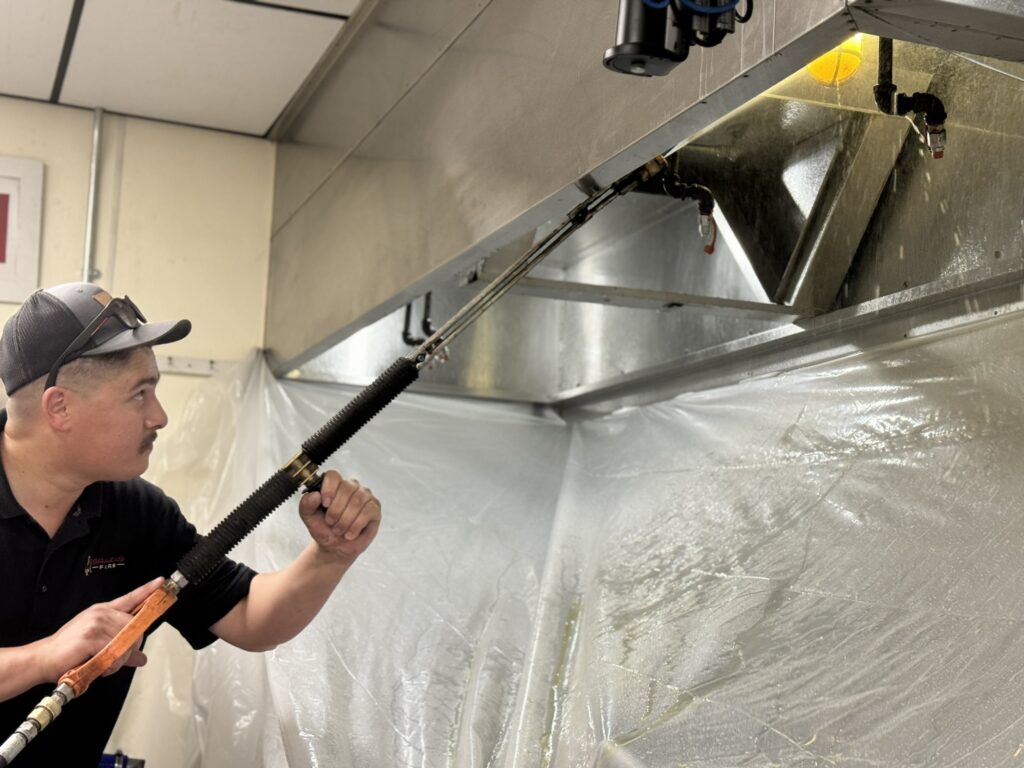
Commercial cooking creates smoke, heat, moisture, and grease-laden vapors.
The exhaust system is designed to capture and move those cooking byproducts away from the kitchen.
A simplified pathway looks like this:
Cooking Equipment
↓
Hood
↓
Grease-Removal Components
↓
Exhaust Ductwork
↓
Rooftop Exhaust Fan
↓
Roof / Discharge Area
Grease does not necessarily stop at the visible hood.
As grease-laden exhaust moves through the system, deposits can accumulate on surfaces along the exhaust pathway. This is why professional commercial kitchen exhaust cleaning may include the hood, exhaust ductwork, fan cleaning, and grease removal rather than simply cleaning the visible stainless-steel canopy. Brazas Fire specifically identifies complete hood cleaning, exhaust duct cleaning, fan cleaning, grease removal, and scheduled maintenance as components of its Kitchen Exhaust Hood Cleaning services.
The longer grease is allowed to accumulate, the more important the condition of the entire exhaust system becomes.
What Happens as Grease Continues to Accumulate?
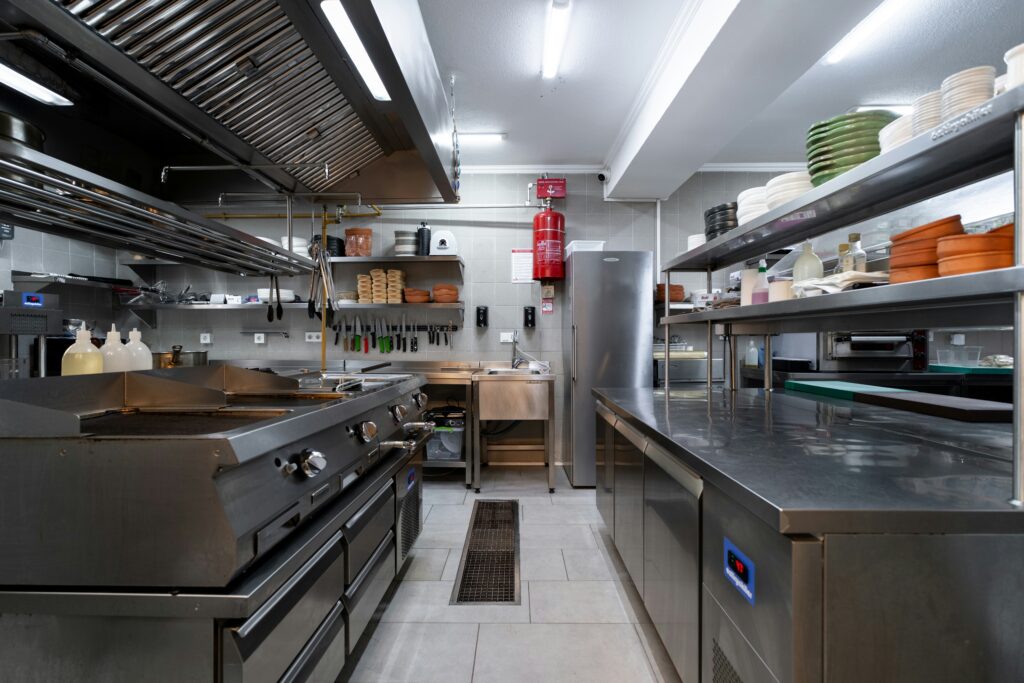
The consequences depend on the kitchen, cooking volume, type of cooking, exhaust-system configuration, maintenance history, and amount of grease accumulation.
But several problems can develop when commercial hood cleaning is neglected.
Neglected Area | Potential Result |
Hood interior | Increasing grease accumulation |
Exhaust ductwork | Hidden grease deposits |
Exhaust fan | Grease accumulation around fan components |
Rooftop area | Grease contamination and maintenance concerns |
Exhaust pathway | More combustible material |
Future cleaning | Heavy deposits may require additional work |
Fire-safety program | Increased maintenance and inspection concerns |
The important point is that these problems can extend beyond what restaurant employees can see from the kitchen floor.
A hood that looks acceptable from below does not necessarily tell you the condition of the ductwork or rooftop exhaust equipment.
Does a Dirty Commercial Kitchen Hood Increase Fire Risk?
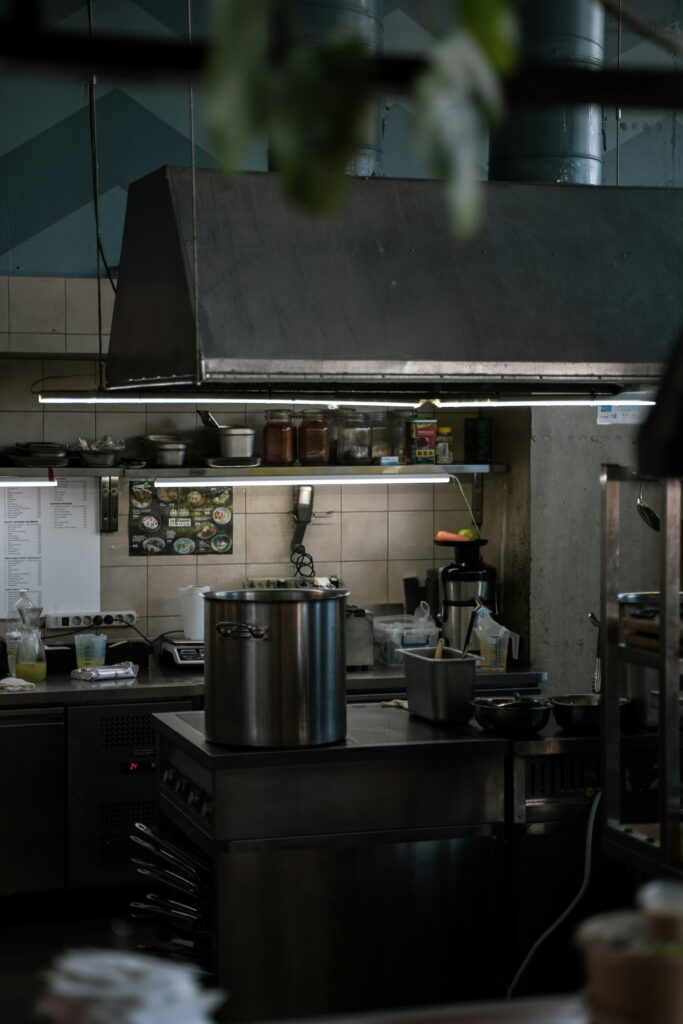
Neglected grease buildup can increase fire hazards because accumulated grease adds combustible material to the commercial kitchen exhaust pathway.
This does not mean that every dirty restaurant hood is about to catch fire.
It does mean that allowing combustible grease deposits to continue accumulating is contrary to good restaurant fire-prevention practices.
Brazas Fire’s company knowledge base identifies grease accumulation as a major contributor to kitchen exhaust fires and recommends regular kitchen exhaust cleaning as part of restaurant maintenance.
Consider what can happen if a cooking fire begins beneath the hood.
The hood is connected to the ductwork, and the ductwork leads toward the exhaust fan. Grease deposits located along that pathway represent additional combustible material that you do not want accumulating unnecessarily.
Professional hood cleaning therefore serves an important preventive purpose:
Remove accumulated grease before it becomes a larger fire hazard.
For a deeper explanation of this relationship, restaurant owners should also review
Why Is Restaurant Kitchen Hood Cleaning Important for Fire Prevention?
Hood cleaning is only one component of commercial kitchen fire protection. Brazas Fire also installs, inspects, tests, maintains, repairs, and recharges commercial kitchen hood fire suppression systems.
Can Grease Build Up Inside the Exhaust Ductwork?
Yes.
This is one of the most important things restaurant owners should understand about commercial hood cleaning.
The grease you can see may not be the grease that matters most.
Employees typically have access to the visible hood, grease-removal components, and surfaces around the cooking line. They generally cannot see far inside the exhaust ductwork.
That creates a potentially misleading situation.
A Clean-Looking Hood Doesn’t Necessarily Mean a Clean Exhaust System
What Restaurant Staff May See | What May Be Hidden |
Clean-looking hood surfaces | Grease inside ductwork |
Greasy filters | Deposits farther into the exhaust pathway |
Grease near the cooking line | Fan grease accumulation |
Hood discoloration | Rooftop contamination |
Surface buildup | Difficult-to-access grease deposits |
Brazas Fire’s editorial standards specifically identify commercial kitchen exhaust systems, hood and duct cleaning, rooftop exhaust fans, grease containment, and exhaust fan hinge kits as areas in which the company’s educational content should demonstrate practical expertise.
That system-wide perspective is important.
Simply wiping down the visible hood does not tell you whether the entire exhaust pathway is adequately maintained.
Can a Commercial Kitchen Hood Look Clean While the Ductwork Is Dirty?
Yes. The appearance of the visible hood does not necessarily tell you how much grease has accumulated farther inside the exhaust system.
This is one reason restaurant owners should not wait for the hood to look extremely dirty before thinking about professional cleaning.
Routine restaurant housekeeping can keep visible surfaces looking reasonably clean while grease accumulation develops elsewhere in the exhaust system.
The visible hood and the hidden exhaust pathway should therefore be considered separately.
Professional exhaust cleaning addresses areas beyond what employees normally reach during daily or weekly kitchen cleaning.
What Happens to the Rooftop Exhaust Fan?
The rooftop exhaust fan is part of the same system.
Grease-laden air travels through the hood and ductwork toward the exhaust fan. As a result, grease can accumulate around accessible fan components and the fan housing.
Brazas Fire specifically identifies dirty rooftop exhaust fans as a common customer problem and provides rooftop exhaust fan cleaning as one of its commercial kitchen services.
The problem with the rooftop fan is visibility.
Restaurant employees may spend every day around the hood and cooking equipment but rarely inspect the roof. Grease buildup around rooftop exhaust equipment can therefore be easy to overlook.
This is also where proper access becomes important.
Brazas Fire installs UL-approved exhaust fan hinge kits that allow rooftop exhaust fans to be safely opened during required cleaning.
A hinge kit does not clean the fan by itself. It helps provide access so the exhaust fan and areas beneath it can be properly serviced.
Can Restaurant Exhaust Grease Damage or Contaminate the Roof?
Grease discharged or accumulated around rooftop exhaust equipment can create additional building-maintenance concerns.
Brazas Fire identifies roof contamination among the common restaurant problems it encounters.
This is where grease containment systems become relevant.
Brazas Fire installs and maintains rooftop grease containment systems designed to prevent grease runoff and roof damage.
That means restaurant owners should think about grease management as extending all the way from the cooking line to the roof:
Cooking equipment → hood → ductwork → exhaust fan → rooftop area
A problem that starts as cooking grease inside the kitchen can eventually become a maintenance concern outside the building if the overall exhaust system is neglected.
Can Neglected Hood Cleaning Affect Exhaust-System Performance?
Heavy grease accumulation should be treated as an exhaust-system maintenance concern.
However, it is important not to exaggerate what a dirty hood will do.
A neglected exhaust system does not automatically mean the fan will fail, nor is there one universal percentage by which grease buildup reduces airflow.
The practical issue is simpler:
Commercial exhaust equipment should not be allowed to accumulate unnecessary heavy grease deposits.
Regular cleaning gives technicians an opportunity to remove grease from serviceable components and observe the condition of the exhaust system as part of ongoing maintenance.
Brazas Fire’s approach emphasizes preventative maintenance, long-term reliability, and value over shortcuts.
Does Waiting Longer Make Hood Cleaning More Difficult?
It can.
Grease deposits do not disappear when cleaning is postponed. If commercial cooking continues, additional grease can continue entering the exhaust system.
A regularly maintained system may therefore be easier to clean than one containing extensive accumulated deposits.
That does not mean every overdue hood automatically costs more to clean.
Commercial kitchen hood cleaning prices can depend on factors such as:
- Hood size
- Exhaust-system configuration
- Ductwork
- Fan access
- Amount and condition of grease buildup
- Number of exhaust components
- Accessibility
- Overall scope of work
But severe buildup can require additional cleaning effort.
Restaurant owners who are concerned about price can also review How Much Does Commercial Kitchen Hood Cleaning Cost in Albuquerque?
The better maintenance strategy is not to wait until grease becomes extreme before calling a professional.
Can a Dirty Restaurant Hood Cause Inspection or Compliance Problems?
Excessive grease accumulation can create fire-safety and compliance concerns.
Commercial cooking exhaust systems are subject to applicable inspection, cleaning, maintenance, and fire-safety requirements. Brazas Fire identifies NFPA 96 – Ventilation Control and Fire Protection of Commercial Cooking Operations as an authoritative resource relevant to commercial kitchen exhaust and fire protection.
However, restaurant owners should be careful about oversimplified claims regarding cleaning schedules and violations.
Missing one particular cleaning date does not automatically mean every restaurant has committed the same violation.
The appropriate inspection and cleaning requirements depend on factors including the cooking operation, grease accumulation, system condition, applicable requirements, and findings during inspection.
A more accurate principle is:
Commercial kitchen exhaust systems should be inspected and cleaned as required based on the cooking operation, grease accumulation, and applicable fire-safety requirements.
Brazas Fire’s educational standards also specifically require its content to remain calm and compliance-aware rather than sensational or fear-driven.
Can Restaurant Employees Clean the Hood Themselves?
Restaurant employees can perform routine cleaning of appropriate accessible surfaces.
That is good housekeeping.
But routine employee cleaning and professional commercial exhaust cleaning are not the same service.
Employees may clean:
- Visible stainless-steel surfaces
- Appropriate accessible hood surfaces
- Cooking-line areas
- Other routinely maintained kitchen surfaces
Professional exhaust cleaning addresses the broader exhaust system and grease accumulation in areas that ordinary kitchen cleaning may not reach.
Brazas Fire’s professional Kitchen Exhaust Hood Cleaning services include complete hood cleaning, exhaust duct cleaning, fan cleaning, grease removal, and scheduled maintenance.
That is the key distinction:
Daily cleaning helps maintain the kitchen. Professional hood cleaning addresses grease accumulation throughout serviceable portions of the exhaust system.
How Often Should Commercial Kitchen Hoods Be Cleaned?
There is not one cleaning interval that should simply be applied to every commercial kitchen without considering the operation.
Cleaning needs can vary based on factors such as:
- Cooking volume
- Type of cooking
- Amount of grease produced
- Hours of operation
- Exhaust-system condition
- Inspection findings
Brazas Fire recommends that restaurants clean kitchen exhaust systems regularly as part of preventive maintenance.
Restaurant owners who want a more detailed explanation should review How Often Should Commercial Kitchen Hoods Be Cleaned?
The important maintenance principle is not to wait until severe grease buildup becomes obvious.
What Are the Signs a Commercial Kitchen Hood Needs Cleaning?
Visible grease can certainly be a warning sign, but restaurant owners should not rely exclusively on what they can see.
Potential reasons to evaluate the exhaust system include:
- Visible grease accumulation inside the hood
- Heavy or sticky deposits on accessible surfaces
- Grease buildup around exhaust components
- Grease accumulation around the rooftop fan
- Rooftop grease contamination
- An unknown or overdue professional cleaning history
- Inspection findings identifying grease accumulation
- Uncertainty about the condition of hidden ductwork
Brazas Fire’s company materials identify grease buildup, improper hood cleaning, fan grease accumulation, and roof contamination among common restaurant problems.
The important point is that visible grease is only one indicator.
The condition of the hidden ductwork and rooftop equipment cannot necessarily be determined by looking up at the hood from the kitchen floor.
What Should You Do If Your Restaurant Hood Has Heavy Grease Buildup?
If you can already see significant grease accumulation—or you do not know when the exhaust system was last professionally cleaned—it may be time to have the system evaluated by a qualified commercial hood-cleaning company.
Avoid treating the visible hood as the entire problem.
Ask about the condition and cleaning of:
- The hood
- Exhaust ductwork
- Rooftop exhaust fan
- Accessible fan housing and related exhaust components
- Rooftop grease accumulation
Brazas Fire provides commercial kitchen hood cleaning, restaurant exhaust-system cleaning, rooftop exhaust-fan cleaning, grease containment systems, and exhaust fan hinge kits.
The company also identifies itself as a Phil Ackland Qualified Company for commercial kitchen hood cleaning.
That allows Albuquerque restaurant owners to address the exhaust pathway as a complete system rather than concentrating only on the visible canopy.
Waiting for Heavy Buildup vs. Preventive Hood Cleaning
Waiting for Heavy Buildup | Preventive Hood Cleaning |
Grease continues accumulating | Deposits are periodically removed |
Hidden areas may accumulate grease | Exhaust system is regularly serviced |
Cleaning may become more intensive | Maintenance remains scheduled |
Rooftop contamination may increase | Fan and exhaust areas can be addressed |
Fire hazards may increase | Combustible grease is reduced |
Preventive hood cleaning does not eliminate every possibility of a commercial kitchen fire.
It addresses one specific and important hazard: accumulated grease in the exhaust system.
Commercial kitchen fire protection also includes properly maintained suppression systems, appropriate fire extinguishers, equipment maintenance, employee safety practices, inspections, and documentation.
Brazas Fire approaches fire protection as an ongoing responsibility involving proper equipment, inspections, testing, maintenance, cleaning, documentation, and timely repairs.
Frequently Asked Questions About Dirty Commercial Kitchen Hoods
What Happens If You Don’t Clean a Commercial Kitchen Hood?
Grease can continue accumulating in the hood, exhaust ductwork, and rooftop exhaust fan. Over time, neglected grease buildup can increase fire hazards, contribute to exhaust and rooftop maintenance problems, make future cleaning more difficult, and create potential inspection or compliance concerns.
Is a Dirty Restaurant Hood a Fire Hazard?
Accumulated grease can add combustible material to the commercial kitchen exhaust pathway. This is why regular exhaust cleaning is an important part of restaurant fire prevention and preventive maintenance. Brazas Fire’s company materials identify grease accumulation as a major contributor to kitchen exhaust fires.
Can Grease in a Restaurant Hood Catch Fire?
Grease deposits are combustible. Allowing significant grease deposits to accumulate inside a commercial kitchen exhaust system can therefore increase fire hazards. Professional exhaust cleaning helps reduce that hazard by removing accumulated grease.
Can Grease Accumulate Inside Commercial Kitchen Ductwork?
Yes. Grease-laden exhaust travels beyond the visible hood and through the exhaust pathway. Brazas Fire specifically provides exhaust duct cleaning and grease removal as part of its commercial kitchen hood-cleaning services.
Can a Hood Look Clean While the Ductwork Is Dirty?
Yes. Cleaning the visible hood does not necessarily tell you the condition of hidden ductwork or rooftop exhaust components. This is one reason professional exhaust-system cleaning is different from ordinary kitchen surface cleaning.
What Happens When Grease Builds Up on a Rooftop Exhaust Fan?
Grease accumulation on and around the exhaust fan can become an additional cleaning and maintenance concern. Brazas Fire identifies fan grease accumulation and roof contamination among common restaurant problems.
Can Restaurant Exhaust Grease Damage the Roof?
Grease runoff around rooftop exhaust equipment can contribute to roof damage and contamination. Brazas Fire provides grease containment systems designed to help prevent grease runoff and roof damage.
Does Heavy Grease Buildup Make Hood Cleaning Harder?
It can. Extensive accumulated deposits may require more cleaning effort than a regularly maintained exhaust system. The actual scope and cost depend on the system and its condition.
Can a Dirty Restaurant Hood Fail an Inspection?
Excessive grease accumulation can create fire-safety and compliance concerns, but inspection outcomes depend on the system’s condition and applicable requirements. It would be inaccurate to say that every dirty hood automatically results in a failed inspection.
Is Cleaning the Visible Kitchen Hood Enough?
Not necessarily. Professional commercial kitchen exhaust cleaning may address the hood, exhaust ductwork, fan, and accumulated grease throughout accessible portions of the exhaust pathway. Brazas Fire lists complete hood cleaning, duct cleaning, fan cleaning, and grease removal among its services.
Does Hood Cleaning Replace Fire Suppression Inspection?
No. Hood cleaning removes accumulated grease from the exhaust system. Kitchen hood fire suppression inspection and maintenance address the fire suppression equipment. Brazas Fire provides both services separately.
How Often Should a Commercial Kitchen Hood Be Professionally Cleaned?
Cleaning needs vary according to the cooking operation, grease accumulation, exhaust-system condition, and applicable requirements. Restaurant operators should follow an appropriate inspection and cleaning schedule rather than waiting for heavy grease buildup.
Schedule Commercial Kitchen Hood Cleaning in Albuquerque
A dirty-looking hood can tell you that a restaurant has a grease problem.
A clean-looking hood cannot necessarily tell you that it doesn’t.
Grease-laden exhaust can travel beyond the visible canopy into ductwork and toward the rooftop exhaust fan. When professional cleaning is continually postponed, grease can continue accumulating in portions of the exhaust system that employees rarely see.
Brazas Fire provides commercial kitchen hood cleaning, exhaust duct cleaning, fan cleaning, grease removal, and scheduled maintenance for commercial kitchens.
The company serves Albuquerque as its primary market and provides commercial fire-protection and kitchen-exhaust services to businesses throughout New Mexico.
Brazas Fire’s internal linking strategy specifically places hood cleaning within a larger Restaurant Fire Safety content cluster and calls for hood-cleaning content to connect with hood suppression, grease containment, exhaust fan hinge kits, and NFPA 96 compliance.
If you are unsure when your commercial kitchen exhaust system was last professionally cleaned—or you can already see significant grease accumulation—call Brazas Fire at 505-889-8999 to schedule commercial kitchen hood cleaning or request a quote for your Albuquerque restaurant or commercial kitchen.