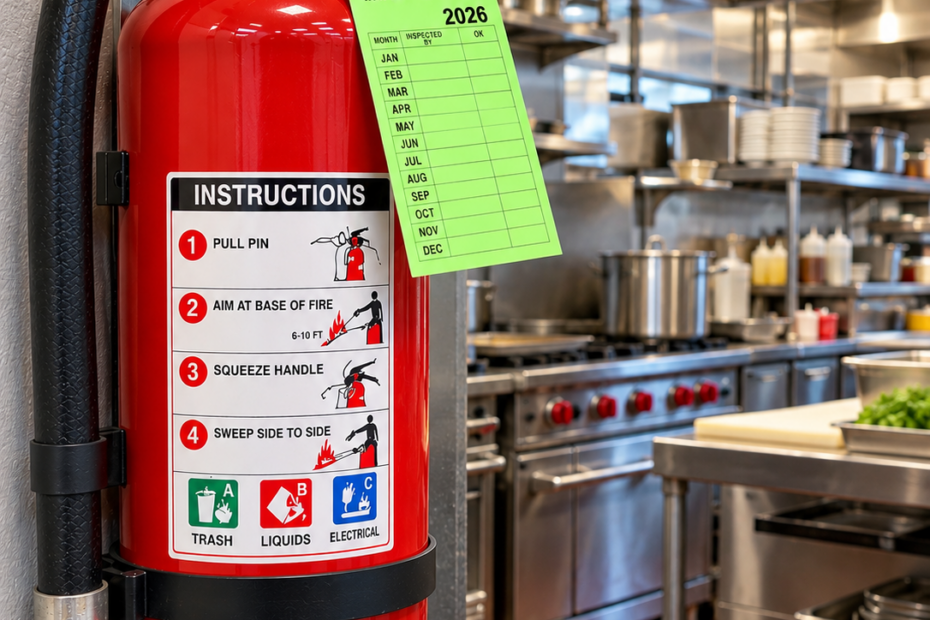
Yes. Many commercial fire extinguishers can be inspected, maintained, and tagged on-site at your Albuquerque business by a properly qualified service provider. However, not every service can be completed at your location. Recharging, internal maintenance, repairs, and hydrostatic testing may require specialized equipment or work at an off-site facility.
The difference depends on the extinguisher’s type, condition, service requirements, and the equipment available to the technician.
For Albuquerque restaurants, offices, warehouses, retail stores, and other commercial properties, on-site fire extinguisher service can reduce the need to transport equipment. It also allows a technician to examine extinguishers in their normal locations and identify problems with accessibility or placement.
The important question isn’t simply whether a company offers mobile service. It’s whether the company can perform the specific maintenance your extinguishers need while keeping your business adequately protected.
What Fire Extinguisher Services Can Be Performed On-Site?
An on-site fire extinguisher appointment may involve several different activities. Some are relatively straightforward, while others require specialized equipment, additional procedures, or a properly equipped service facility.
The following comparison explains what business owners can generally expect.
Fire extinguisher service | Can it be performed on-site? | Important considerations |
Monthly visual inspection | Yes | Usually performed by a designated employee |
Annual professional maintenance and tagging | Often | Depends on extinguisher condition and service requirements |
Fire extinguisher recharging | Sometimes | Requires appropriate equipment, extinguishing agent, and authorized personnel |
Six-year internal maintenance, where applicable | Depends | May require workshop equipment and additional procedures |
Hydrostatic testing | Usually at a specialized facility | Requires approved testing procedures and equipment |
Minor component replacement | Sometimes | Depends on the component, manufacturer, and available parts |
Major repairs or cylinder replacement | Often off-site | Some damaged extinguishers must be removed from service |
Replacement with a new extinguisher | Often possible at the business | Correct type, rating, and placement must be maintained |
These are general service-location expectations, not guarantees that every provider performs each activity at a customer’s property.
A company offering mobile fire extinguisher inspections may still need to transport certain extinguishers to its shop for recharging or testing.
Annual Fire Extinguisher Maintenance and Tagging
Annual maintenance is one of the services commonly performed during a commercial on-site visit.
A qualified technician examines each extinguisher according to the applicable requirements. The work may include checking the cylinder, operating components, hose, nozzle, pressure indication, and evidence of damage or deterioration.
When the required maintenance is completed satisfactorily, the technician documents the service and updates the applicable maintenance tag or record.
The technician may also identify extinguishers that need additional attention.
For example, an extinguisher with an overdue annual tag might be suitable for routine maintenance. Another unit in the same building could have corrosion, damaged components, or evidence of discharge that requires further evaluation.
An annual maintenance visit does not mean every extinguisher will automatically receive a new tag and remain in service.
For a closer look at professional maintenance, see What Occurs During a Fire Extinguisher Inspection or Maintenance Visit?.
Can Fire Extinguishers Be Recharged On-Site?
Some commercial fire extinguishers can be recharged on-site when the provider has the proper equipment, materials, authorization, and a suitable work area. Others must be transported to a service facility.
Recharging is more involved than an ordinary maintenance examination.
A rechargeable extinguisher must be serviced using the correct extinguishing agent, pressurizing method, replacement components when needed, and manufacturer-approved procedures.
The service location must also be suitable for the work.
A mobile technician may be equipped to recharge certain models but not others. For example, a standard ABC dry chemical extinguisher and a Class K wet chemical extinguisher use different agents and servicing procedures.
If an extinguisher has been discharged, damaged, or found to have an abnormal pressure condition, ask the service company whether it can evaluate and recharge that particular model at your location.
The decision to recharge or replace an extinguisher is explained further in Can I Recharge a Used Fire Extinguisher or Do I Need to Replace It?.
Which Fire Extinguisher Services Usually Require an Off-Site Facility?
Some maintenance activities require equipment and conditions that may not be available during a routine mobile appointment.
The most important examples are hydrostatic testing, certain internal maintenance procedures, and extensive repairs.
Hydrostatic Testing
Hydrostatic testing checks the integrity of an extinguisher’s pressure-containing components using prescribed testing procedures.
It is not the same as checking the pressure gauge.
The testing requires appropriate equipment, trained personnel, and specific procedures for the extinguisher involved.
Because of these requirements, hydrostatic testing is commonly performed at a properly equipped service facility.
Testing intervals vary by extinguisher type. For example, certain stored-pressure dry chemical extinguishers have different hydrostatic testing requirements from carbon dioxide extinguishers.
Business owners should not assume that every extinguisher is tested on the same schedule.
A qualified service provider can review the equipment’s markings and service history to determine whether testing is due.
Six-Year Internal Maintenance
Certain stored-pressure dry chemical extinguishers require internal maintenance at six-year intervals under applicable requirements.
This involves more than an external examination.
The work may require removing the extinguishing agent, examining internal components, replacing applicable parts, and restoring the extinguisher to service.
Whether this can be completed at the business depends on the extinguisher and the provider’s equipment and approved procedures.
A business scheduling annual maintenance should identify any units approaching longer-term service intervals so the provider can plan accordingly.
Damaged or Nonrechargeable Extinguishers
Not every extinguisher can be repaired or recharged.
A nonrechargeable extinguisher is designed for replacement rather than refilling after use.
A rechargeable extinguisher may also require replacement when damage, deterioration, failed testing, or manufacturer restrictions make continued service inappropriate.
A technician should evaluate the condition rather than automatically recommend recharging.
This is especially important for older extinguishers with an incomplete maintenance history.
What Qualifications Must an On-Site Fire Extinguisher Technician Have in New Mexico?
New Mexico regulates fire protection equipment work through its certificate-of-fitness requirements.
The state’s rules address the qualifications and authorization required for regulated inspection, maintenance, servicing, recharging, and tagging of portable fire extinguishers.
Under 10.25.2 of the New Mexico Administrative Code, portable fire extinguishers are identified as a specific fire protection equipment discipline.
The rule is important because a company offering mobile service must still meet the applicable state requirements.
A mobile service vehicle does not, by itself, establish that a technician is authorized to service commercial extinguishers.
The person performing regulated work should have the appropriate authorization for the equipment and activities involved.
New Mexico’s regulatory framework also addresses fire extinguisher service operations, including mobile and fixed-location arrangements.
When selecting a provider, ask whether its credentials and equipment cover the specific services you need.
For information about state fire protection requirements, the New Mexico State Fire Marshal is an appropriate starting point.
How Should an Albuquerque Business Prepare for an On-Site Service Appointment?
A little preparation can make the visit more efficient, especially when a business has extinguishers spread across several rooms, floors, or buildings.
The first step is knowing how many extinguishers you have and where they are located.
Create a Simple Fire Extinguisher Inventory
Before scheduling, record the following information for each extinguisher:
- Location: Kitchen, warehouse, office hallway, loading dock, mechanical room, or other designated area.
- Extinguisher type: ABC dry chemical, Class K wet chemical, carbon dioxide, or another type.
- Size and rating: Information shown on the extinguisher label.
- Last maintenance date: The date recorded on the annual maintenance tag or service record.
- Known problems: Damage, discharge, low-pressure indication, missing components, or other concerns.
- Special service dates: Internal maintenance or hydrostatic testing information, when available.
A useful inventory might identify an extinguisher as “Warehouse east exit, 10-pound ABC, annual maintenance due October.”
That information is more helpful than simply telling the provider that the building has several extinguishers.
If you manage multiple Albuquerque locations, separate the inventory by address and building.
Make Every Extinguisher Accessible
Technicians need access to the equipment they are scheduled to examine.
Before the appointment, check for extinguishers hidden behind stored merchandise, blocked by equipment, or located in rooms that require a key.
Arrange access to locked offices, commercial kitchens, maintenance rooms, and other restricted areas.
If equipment must be moved temporarily, coordinate with the service provider so required extinguisher locations remain properly protected.
Ask About Parking and Work Area Requirements
An on-site appointment may require more than access to the extinguishers themselves.
Depending on the work, the service provider may need vehicle access, a designated work area, or a location suitable for handling equipment.
Ask whether the work will take place inside the building, near a service vehicle, or at an off-site facility.
For restaurants and other busy properties, scheduling around deliveries or operating hours may make access easier.
What Happens If an Extinguisher Must Be Removed for Service?
Your business must address required fire extinguisher protection while a unit is out of service. An extinguisher removed for recharging, repair, or testing should not leave an unaddressed gap in required coverage.
The appropriate solution depends on the building’s hazards, extinguisher locations, applicable fire code, and the work being performed.
In some situations, a suitable replacement extinguisher may be needed while the original unit is away.
The replacement should provide the appropriate fire classification and rating for that location.
Moving an extinguisher from another part of the building is not automatically an acceptable solution. Doing so could leave a different area without required protection.
Why Extinguisher Placement Matters
Commercial extinguishers must be selected and located based on the hazards present and the applicable requirements.
A restaurant cooking area may require Class K protection, while an office or warehouse may use multipurpose ABC extinguishers.
Travel distance, accessibility, and the number of extinguishers needed can also affect the arrangement.
For workplaces covered by OSHA’s portable fire extinguisher standard, 29 CFR 1910.157, employers have responsibilities involving extinguisher selection, distribution, accessibility, inspection, and maintenance.
That OSHA regulation is useful because it explains employer responsibilities for workplace extinguishers. It does not replace applicable state or local fire code requirements.
Does a Green Pressure Gauge Mean the Extinguisher Can Stay in Service?
Not necessarily.
A gauge in the indicated operating range does not rule out corrosion, damaged components, a blocked nozzle, an overdue maintenance requirement, or other problems.
An extinguisher can appear properly pressurized and still need professional attention.
For more information, read Can a Fire Extinguisher Fail Inspection Even If the Pressure Gauge Is Green?.
How Would On-Site Service Work for an Albuquerque Restaurant?
Consider a hypothetical Albuquerque café with four ABC extinguishers and one Class K extinguisher.
The owner schedules annual maintenance and provides the service company with an inventory of the five units.
During the appointment, the technician examines the extinguishers and completes the maintenance that can properly be performed at the property.
Three ABC extinguishers and the Class K unit are suitable for the required annual maintenance.
The fourth ABC extinguisher shows evidence of discharge and needs additional work.
Rather than simply updating its tag, the technician determines whether it can be recharged and whether the required work can be completed at the property.
If the unit must leave the premises, the owner arranges suitable temporary protection.
The Class K extinguisher remains in its required location because it protects against cooking hazards that are different from those addressed by the café’s other extinguishers.
The café’s kitchen hood fire suppression system is also a separate piece of equipment with its own inspection and maintenance requirements.
Businesses operating commercial kitchens can learn more about kitchen hood fire suppression systems in Albuquerque.
This example illustrates an important point: an on-site visit can involve routine maintenance, additional service recommendations, and equipment that must be removed or replaced.
What About a Warehouse with Extinguishers Due for Testing?
Now consider an Albuquerque warehouse with extinguishers near the loading dock, storage aisles, offices, and maintenance areas.
Most units may be eligible for routine annual maintenance at the property.
However, service records show that two extinguishers are due for hydrostatic testing.
Those units may need to be transported to a properly equipped testing facility.
The warehouse manager should identify the affected locations before the appointment and discuss how required protection will be maintained.
This is particularly important when extinguishers are located near areas with distinct hazards.
A warehouse should not assume that every extinguisher is interchangeable simply because the cylinders look similar.
A provider can help identify which units need routine maintenance, additional testing, or replacement.
How Much Does On-Site Fire Extinguisher Service Cost in Albuquerque?
The cost depends on the work required, the number and types of extinguishers, service location, and the provider’s pricing structure.
An annual maintenance visit involving several serviceable extinguishers is different from an appointment requiring recharging, replacement parts, hydrostatic testing, or new equipment.
Mobile service may also involve travel or service-call charges.
When requesting a quote, ask whether the price includes annual maintenance, tagging, travel, and documentation.
Also ask how additional work will be handled if the technician finds an extinguisher that requires recharging or testing.
A useful estimate should help you distinguish the planned maintenance cost from potential additional services.
For a more detailed explanation, see How Much Does Fire Extinguisher Service Cost in Albuquerque?.
Frequently Asked Questions About On-Site Fire Extinguisher Service
Can a Technician Inspect and Tag Every Extinguisher During One Visit?
A technician may be able to examine an entire inventory during one appointment, but each extinguisher must meet the applicable maintenance requirements before the appropriate service documentation is completed. Damaged or overdue equipment may need additional work.
Can an On-Site Appointment Cover Several Business Locations?
Some providers coordinate service across multiple properties. Scheduling depends on the addresses, equipment inventory, travel requirements, and available service arrangements. Ask whether separate appointments or coordinated visits are appropriate.
Does a Discharged Fire Extinguisher Always Need Replacement?
No. A rechargeable extinguisher may be returned to service after proper evaluation and recharging. A nonrechargeable extinguisher must be replaced after use, and a damaged rechargeable unit may also require replacement.
Can Class K Extinguishers Be Serviced During the Same Visit as ABC Extinguishers?
Potentially. However, Class K and ABC extinguishers use different extinguishing agents and service procedures. Confirm that the provider is equipped and authorized to service both types during the appointment.
Does On-Site Service Mean Hydrostatic Testing Can Be Done in My Parking Lot?
No. On-site maintenance does not automatically include hydrostatic testing. Pressure testing requires specialized equipment and procedures and is commonly performed at a properly equipped facility.
How Often Do Commercial Fire Extinguishers Need Professional Service?
The schedule depends on the equipment and applicable requirements. Annual maintenance is a common requirement, while certain extinguishers also need periodic internal maintenance or hydrostatic testing. Learn more in How Often Do Commercial Fire Extinguishers Need Professional Service in New Mexico?.
Schedule Commercial Fire Extinguisher Service in Albuquerque
On-site service can be a practical option for Albuquerque businesses, especially when extinguishers need routine annual maintenance and tagging. More involved work may require specialized equipment or an off-site service facility.
Brazas Fire provides commercial fire extinguisher sales, inspections, annual maintenance, recharging, hydrostatic testing, and replacement services for businesses in Albuquerque, Rio Rancho, Santa Fe, and other New Mexico communities.
If you need extinguisher service at your business, contact Brazas Fire to discuss your equipment and determine which services can be arranged at your location.
Having the number of extinguishers, their types, locations, and maintenance dates available will help identify what your property needs.
Call Brazas Fire at 505-889-8999 or visit the company’s commercial fire extinguisher service page to discuss your service requirements.
Brazas Fire
2900 Wellesley Dr. NE
Albuquerque, NM 87107
Phone: 505-889-8999
The goal is to complete the necessary maintenance while ensuring your business retains the fire protection equipment it needs.