Commercial kitchen hood grease filters work every day to capture grease-laden vapors before they travel farther into the exhaust system. When filters are clean, properly installed, and in good condition, they support effective smoke capture, steady airflow, and a cleaner kitchen environment.
When they become heavily coated with grease, airflow may decline. Smoke and cooking odors can begin escaping from beneath the hood, temperatures around the cooking line may rise, and additional grease can move into the hood plenum, ductwork, and exhaust fan.
Restaurant owners and kitchen managers can reduce these problems by cleaning their grease filters regularly between scheduled professional exhaust-system cleanings.
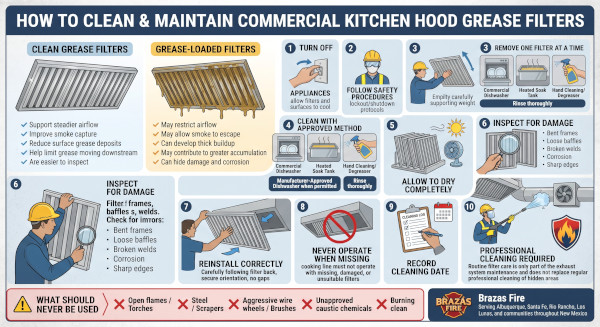
The basic process is straightforward: remove the filters after the cooking equipment has cooled, clean them using a manufacturer-approved commercial dishwasher, soak tank, or degreasing process, rinse them thoroughly, allow them to dry, inspect them for damage, and reinstall them in the correct position.
However, grease-filter maintenance must be performed safely and consistently. Filters should not be removed while cooking appliances are operating, and the hood should never be operated with missing, damaged, incorrectly positioned, or unsuitable replacement filters.
Routine filter cleaning is important, but it addresses only one part of the exhaust system. It does not remove grease from the hood plenum, ductwork, rooftop fan, or other concealed areas. Professional kitchen hood and exhaust cleaning remain an essential part of a complete commercial kitchen fire-prevention program.
The Direct Answer on How to Clean and Maintain Commercial Kitchen Hood Grease Filters
To clean commercial kitchen hood grease filters between professional cleanings:
- Turn off the cooking appliances and allow the filters and surrounding surfaces to cool.
- Follow your restaurant’s lockout, shutdown, and employee-safety procedures.
- Remove one filter at a time while supporting its weight with both hands.
- Clean the filter using a method approved by its manufacturer.
- Use a commercial dishwasher, heated soak tank, or appropriate degreasing solution when permitted.
- Rinse away loosened grease and cleaning residue.
- Allow the filter to drain and dry completely.
- Inspect it for bent frames, damaged baffles, broken welds, corrosion, or sharp edges.
- Reinstall it in the correct orientation and make sure no openings remain in the filter bank.
- Record the cleaning date and adjust the schedule if filters are becoming loaded faster than expected.
The appropriate cleaning frequency depends on cooking volume, menu, operating hours, appliance types, filter design, and manufacturer recommendations. Some high-volume kitchens may need to clean filters daily. Other operations may use a rotating schedule several times per week.
The filters should be cleaned often enough so that grease does not become thick, hardened, dripping, or difficult to remove.
What Do Kitchen Hood Grease Filters Do?
Grease filters are installed in the lower section of a commercial kitchen exhaust hood. They sit directly in the path of rising heat, smoke, steam, and grease-laden vapors produced by cooking equipment.
Their purpose is to separate as much grease as practical from the moving air before that air enters the hood plenum and exhaust ductwork.
Many commercial hoods use stainless-steel baffle filters. These filters contain overlapping metal vanes that repeatedly change the direction of the passing air. As the air turns through the baffles, heavier grease particles lose momentum and collect on the metal surfaces.
The captured grease then drains toward collection points built into the hood or filter assembly.
Grease filters do not remove every grease particle. Some grease can still travel into the plenum, duct, and fan, which is why the entire exhaust system requires periodic professional cleaning. However, clean and properly installed filters reduce the amount of grease moving downstream.
Filters are therefore an important first stage of grease control—not a complete exhaust-cleaning system by themselves.
Why Clean Grease Filters Matter
Properly maintained filters support several parts of kitchen operation.
Better Smoke and Vapor Capture
Clean filters allow exhaust air to move through the hood more efficiently. This helps the system capture heat, smoke, steam, and cooking vapors near the appliance line.
When filters become severely restricted, smoke may begin rolling out from beneath the hood or drifting toward food-preparation and dining areas.
Improved Kitchen Airflow
A commercial kitchen exhaust system depends on coordinated airflow. The fan removes contaminated air while the building’s makeup-air system replaces part of that air.
Grease-loaded filters add resistance to the exhaust path. Depending on the design and condition of the system, that restriction may reduce capture performance and contribute to uncomfortable heat around the cooking line.
Reduced Grease Movement into Ductwork
Filters catch grease before they reach less accessible parts of the exhaust system. Keeping them clean supports their ability to separate grease from the airflow.
Dirty filters can allow grease to accumulate more heavily around the filter bank and may contribute to increased deposits in other portions of the system.
Reduced Load on Exhaust Equipment
The exhaust fan must move air through the filter bank, hood, and duct system. When filters become heavily restricted, the system may have to work under less favorable conditions.
Cleaning the filters will not correct a damaged fan, worn belt, poor makeup-air balance, or undersized exhaust system. However, it removes one common source of unnecessary airflow resistance.
Support for Commercial Kitchen Fire Prevention
Grease is combustible. Allowing thick grease deposits to remain on filters adds to the fuel present near cooking appliances.
Routine filter cleaning removes this accumulation before it becomes excessive. It also makes it easier for employees and service technicians to observe the filters’ condition and identify damage or improper installation.
Clean Grease Filters | Grease-Loaded Filters |
Support steadier airflow | May restrict airflow |
Improve smoke capture | May allow smoke to escape |
Reduce surface grease deposits | Can develop thick buildup |
Help limit grease moving downstream | May contribute to greater accumulation |
Are easier to inspect | Can hide damage and corrosion |
How Often Should Commercial Hood Filters Be Cleaned?
There is no single cleaning interval that fits every kitchen.
A restaurant with multiple fryers and charbroilers may load its filters much faster than a facility that primarily bakes, steams, or reheats food. A kitchen operating eighteen hours a day will generally produce more grease than one used only for limited meal service.
Factors affecting cleaning frequency include:
- Cooking volume
- Hours of operation
- Frying and charbroiling activity
- Solid-fuel cooking
- Type of food prepared
- Filter size and design
- Exhaust airflow
- Menu changes
- Seasonal demand
- Catering or production increases
Kitchen managers should establish a routine based on actual filter condition rather than selecting a schedule and ignoring what happens between cleaning dates.
In many busy kitchens, filters may require daily cleaning. Other operations may clean them every few days or on a rotating weekly schedule. Manufacturer instructions and applicable facility procedures should always be followed.
A practical rule is to clean the filters before grease becomes thick, hardened, dripping, or capable of blocking the baffle passages.
A Safe Routine for Removing Grease Filters
Filter maintenance should be performed only after cooking operations have stopped and the appliances, hood surfaces, and filters have cooled sufficiently.
Before removing a filter:
- Turn off the affected cooking equipment.
- Follow established employee-safety and shutdown procedures.
- Make sure no open flame or hot oil is directly beneath the work area.
- Wear appropriate gloves and other protective equipment.
- Prepare a stable cart, sink, rack, or container for transporting greasy filters.
- Confirm that replacement or spare filters are available when the hood must remain operational.
Grease-coated filters can be heavier and more slippery than they appear. Employees should support each filter with both hands and avoid standing directly beneath it while releasing it from the hood.
Filters should generally be removed one at a time. This reduces the likelihood of losing control of several greasy panels and helps the employee remember the correct position and orientation of each filter.
Never leave an active cooking line operating with filters removed. The filter bank is part of the approved hood assembly, and open spaces can allow heat and grease-laden vapors to enter the exhaust system differently than intended.
Daily and Weekly Filter Maintenance
A successful maintenance program usually combines brief daily observations with scheduled deep cleaning.
Daily Visual Checks
At the beginning or end of each shift, employees can look for:
- Heavy grease coating
- Grease dripping from filter edges
- Filters sitting unevenly
- Missing filters
- Bent frames
- Broken handles
- Gaps in the filter bank
- Smoke escaping from the hood
- Filters installed backward
- Grease collecting on nearby hood surfaces
Employees should report unusual conditions rather than simply wiping away visible grease and assuming the problem is resolved.
Routine Surface Care
Accessible hood surfaces around the filters may be wiped according to the restaurant’s cleaning procedures. Care should be taken not to disturb:
- Fire-suppression nozzles
- Fusible links
- Detection cable
- Manual pull stations
- Other suppression components
Daily surface cleaning improves appearance and helps control localized grease, but it does not replace removing and cleaning the filters.
Scheduled Filter Cleaning
The restaurant should establish a written schedule based on actual grease production. In high-use kitchens, cleaning may be required daily. Kitchens producing less grease may use a different interval.
A rotating spare-filter set can be helpful. One clean set can be installed while the dirty set is being washed, soaked, rinsed, and dried. This reduces the temptation to reinstall filters before they are fully clean or to operate without a complete filter bank.
Cleaning Filters in a Commercial Dishwasher
Many stainless-steel baffle filters can be cleaned in a commercial dishwasher, provided the filter manufacturer and dishwasher manufacturer allow it.
The general process may include:
- Remove loose grease and debris according to approved procedures.
- Position the filter securely in the dishwasher rack.
- Avoid overcrowding the machine.
- Use an approved detergent.
- Run the appropriate commercial wash cycle.
- Inspect the filter after washing.
- Repeat the cycle if significant grease remains.
- Allow the filter to drain and dry before reinstallation.
A commercial dishwasher can be effective for routine cleaning when filters are serviced frequently enough that grease has not hardened into a thick deposit.
However, there are several practical considerations.
Filters may contain enough grease to affect dishwasher performance, clog strainers, or create sanitation concerns if the same equipment is used for dishes and food-contact items. Management should follow equipment-manufacturer instructions, local sanitation requirements, and the restaurant’s approved procedures.
Highly contaminated filters may require pretreatment or soak-tank cleaning rather than repeated dishwasher cycles.
Aluminum filters may react differently to high heat or alkaline detergents than stainless-steel filters. Never assume that every filter material can be washed using the same method.
Using a Soak Tank
A commercial soak tank uses heated water and an approved cleaning solution to loosen grease from filters and other removable kitchen components.
This method can be useful when filters have heavier buildup that does not release easily in a standard wash cycle.
A typical process includes:
- Confirm that the tank and cleaning solution are suitable for the filter material.
- Follow the chemical manufacturer’s dilution and temperature instructions.
- Lower the filters into the tank carefully.
- Allow them to soak for the recommended time.
- Remove them using the proper tools and protective equipment.
- Rinse them thoroughly.
- Inspect them for remaining deposits.
- Allow them to dry before reinstallation.
The filter should not be left in a chemical solution longer than recommended. Excessive soaking or using an incompatible cleaner can discolor, corrode, weaken, or otherwise damage certain metals.
Employees should receive appropriate chemical-handling training and have access to product labels and safety data sheets. Cleaning products should never be mixed unless the manufacturer specifically permits it.
Hand Cleaning and Degreasing
Some filters may be cleaned in a dedicated sink or approved wash area using hot water, an appropriate degreaser, and non-damaging cleaning tools.
The filter should be rinsed in the direction recommended by the manufacturer to help remove grease from the internal baffle passages.
A soft or medium-duty nylon brush may be appropriate for certain filter surfaces. Abrasive tools should be avoided unless specifically approved.
The goal is to remove grease without:
- Bending the baffles
- Damaging welds
- Distorting the frame
- Leaving chemical residue
- Creating sharp edges
- Removing identification labels
- Changing the filter’s fit
Wastewater and grease should be handled according to facility procedures and applicable environmental or plumbing requirements. Large quantities of grease should not be washed directly into an unsuitable drain.
What Should Never Be Used on Grease Filters?
Improper cleaning can damage a filter even when it removes grease successfully.
Avoid using:
- Open flames
- Torches
- Extremely high uncontrolled heat
- Steel chisels
- Screwdrivers used as scrapers
- Aggressive wire wheels
- Tools that bend the baffles
- Unapproved caustic chemicals
- Chemical combinations that create hazardous reactions
- Pressure strong enough to deform the filter
- Paint or coatings
- Household methods that leave combustible residue
Filters should never be burned clean. Applying flames or uncontrolled heat can damage the filter, create a fire hazard, release fumes, and place employees at risk.
Restaurant staff should also avoid beating filters against hard surfaces to dislodge grease. This can bend the frames or loosen welded components.
Inspecting Filters After Cleaning
Cleaning provides a valuable opportunity to examine each filter closely.
Look for:
- Bent or crushed frames
- Loose baffles
- Broken welds
- Missing handles
- Corrosion
- Cracks
- Sharp edges
- Warping
- Open seams
- Damage that prevents a secure fit
- Missing manufacturer markings
- Grease remaining inside the baffle passages
A filter should sit securely in the hood without large gaps. It should not rock, sag, or fall out of position.
Filters with structural damage should be evaluated for replacement. Trying to hammer or bend a damaged filter back into shape can create additional problems and may not restore the approved configuration.
Filter Condition | Recommended Response |
Light grease film | Perform routine cleaning |
Heavy but removable grease | Use an approved deep-cleaning method |
Bent frame | Replace or professionally evaluate |
Loose or broken baffles | Replace |
Broken welds | Replace |
Significant corrosion | Evaluate for replacement |
Missing filter | Install a proper approved replacement |
Incorrect size or poor fit | Replace with the correct filter |
Reinstalling Grease Filters Correctly
A clean filter can still create problems if it is installed incorrectly.
Many baffle filters have a specific airflow direction or orientation. The baffles and drain openings must be positioned so captured grease moves toward the intended collection area rather than dripping onto the cooking equipment.
When reinstalling filters:
- Follow the manufacturer’s orientation markings.
- Place each filter securely in the upper and lower tracks.
- Confirm that the filter bank has no open spaces.
- Make sure all filters are the correct size and type.
- Verify that handles and drain openings are positioned properly.
- Do not force oversized or bent filters into place.
- Confirm that no suppression nozzle or detection component has been disturbed.
Using filters of different sizes, materials, or designs within the same bank may affect fit and performance. Replacement filters should match the hood manufacturer’s requirements and approved system configuration.
Signs a Grease Filter Needs Replacement
Cleaning cannot restore every filter.
Replacement may be appropriate when the filter has:
- A permanently bent frame
- Broken or separated baffles
- Failed welds
- Advanced corrosion
- Sharp or dangerous edges
- Missing sections
- Warping that creates gaps
- Damage preventing proper drainage
- A size that does not match the hood
- An unknown or unsuitable filter design
A damaged filter may allow grease-laden air to bypass the intended path. It can also fall from the hood or become difficult for employees to remove safely.
Do not replace a commercial grease filter with improvised mesh, household filter material, or a panel chosen only because it fits the opening. The filter should be listed or approved as appropriate for the specific commercial hood.
Common Grease-Filter Maintenance Mistakes
Waiting Until Grease Drips
Grease should not have to drip from the filters before cleaning is scheduled. Dripping indicates that accumulation has already become excessive.
Operating With Missing Filters
Removing dirty filters and continuing to cook without replacements leaves openings in the filter bank. Keep a clean spare set when the kitchen’s operation requires continuous coverage.
Installing Filters Backward
A filter that looks symmetrical may still have a required orientation. Incorrect installation can interfere with drainage and grease capture.
Mixing Filter Types
Combining different sizes, materials, or baffle designs may create gaps and uneven airflow.
Cleaning Only the Visible Side
Grease accumulates inside the baffle passages, not just on the front surface. The cleaning method must reach the internal surfaces.
Using the Wrong Chemical
A cleaner that works on one metal may corrode or discolor another. Manufacturer instructions should guide product selection.
Ignoring Fan or Airflow Problems
Cleaning filters may improve airflow, but it will not repair a damaged belt, motor, fan blade, bearing, or makeup-air problem. Persistent smoke, heat, or fan vibration requires further evaluation.
How NFPA 96 Relates to Grease-Filter Maintenance
NFPA 96 addresses ventilation control and fire protection for commercial cooking operations. It covers the broader exhaust system, including hoods, grease-removal devices, ducts, fans, cleaning, inspection, and coordination with fire-protection equipment.
For restaurant owners, the practical principle is that grease-removal equipment should be kept in serviceable condition and grease accumulation should be controlled.
NFPA 96 should not be treated as a do-it-yourself cleaning manual or a substitute for manufacturer instructions. Exact responsibilities may depend on the equipment, system design, adopted code edition, local health and fire requirements, and the Authority Having Jurisdiction, commonly called the AHJ.
The AHJ is the local organization or official responsible for interpreting and enforcing applicable requirements.
Restaurant managers do not need to memorize technical standards to maintain filters responsibly. They should understand that:
- Filters are part of the approved exhaust system.
- They should remain installed during cooking operations.
- They must be cleaned often enough to prevent excessive buildup.
- Damaged or missing filters require correction.
- Routine filter care does not replace complete exhaust-system cleaning.
- Professional guidance is appropriate when requirements or equipment conditions are unclear.
Preventive Maintenance Recommendations
A written filter-maintenance program can reduce missed cleanings and inconsistent employee practices.
Assigning Responsibility
Designate specific positions or employees responsible for:
- Daily visual checks
- Filter removal
- Cleaning
- Post-cleaning inspection
- Reinstallation
- Documentation
When responsibility is unclear, filter maintenance is more likely to be delayed.
Maintain a Cleaning Log
Record:
- Date cleaned
- Employee or vendor performing the work
- Cleaning method
- Condition observed
- Filters replaced
- Unusual airflow or smoke conditions
- Corrective action requested
The log helps management identify whether filters are becoming dirty faster because of menu, volume, or operational changes.
Keep a Spare Filter Set
A spare set allows the kitchen to maintain a complete filter bank while another set is soaking or drying.
Train Employees
Employees should understand:
- Safe removal procedures
- Correct filter orientation
- Approved chemicals
- Required protective equipment
- Signs of damage
- The importance of reporting smoke, odors, drips, or airflow changes
Reevaluate the Schedule When Operations Change
Review the cleaning frequency after:
- Adding fryers or charbroilers
- Expanding operating hours
- Increasing cooking volume
- Adding catering production
- Changing the menu
- Introducing solid-fuel cooking
- Replacing the hood or exhaust equipment
Why Filter Cleaning Does Not Replace Professional Hood Cleaning
One of the most important distinctions for restaurant owners is the difference between filter maintenance and complete exhaust-system cleaning.
Filters are removable components at the front of the system. Employees can often clean them safely using approved procedures.
Behind the filters are areas that may include:
- The hood plenum
- Ductwork
- Access panels
- Fan housing
- Fan blades
- Rooftop grease-containment components
- Other concealed surfaces
Grease continues accumulating in these locations even when filters are maintained diligently.
Professional kitchen exhaust cleaning requires specialized equipment, access, containment procedures, safety practices, and documentation. Technicians clean accessible portions of the system based on its design and condition, including areas restaurant employees cannot safely reach during routine maintenance.
Filter cleaning may slow downstream accumulation, but it cannot eliminate it.
Frequently Asked Questions
Can I put commercial hood filters in a dishwasher?
Many stainless-steel baffle filters can be cleaned in a commercial dishwasher, but manufacturer instructions should be checked first. Filter material, detergent, temperature, and dishwasher sanitation procedures all matter.
How often should restaurant hood filters be cleaned?
The frequency depends on cooking volume, hours, menu, appliance types, and grease production. Busy frying or charbroiling operations may need daily cleaning. The filters should be cleaned before grease becomes thick, dripping, hardened, or restrictive.
Can filters be cleaned while the cooking line is operating?
Filters should not be removed while the protected cooking equipment is operating. Follow shutdown and employee-safety procedures before removal.
Can we operate briefly without filters?
Commercial cooking should not continue with missing filters or open gaps in the filter bank. Keep a clean spare set when necessary.
Should grease filters be pressure-washed?
Pressure washing may be suitable in some controlled professional applications, but excessive pressure can bend baffles, damage frames, or spread contaminated water. Follow manufacturer guidance and approved facility procedures.
Can aluminum filters be washed like stainless-steel filters?
Not necessarily. Aluminum may react to certain detergents, temperatures, or chemicals. Confirm the material and follow the manufacturer’s cleaning instructions.
Why is smoke still escaping after the filters were cleaned?
Possible causes include fan problems, duct restrictions, poor makeup-air balance, appliance placement, damaged filters, an undersized system, or grease accumulation elsewhere in the exhaust system. A professional evaluation may be needed.
When should a filter be replaced instead of cleaning it?
Replace or professionally evaluate filters with bent frames, broken baffles, failed welds, severe corrosion, sharp edges, warping, or damage that prevents proper fit.
Does filter cleaning satisfy my professional hood-cleaning requirement?
No. Filter maintenance does not clean the plenum, ductwork, fan, or rooftop components. Scheduled professional exhaust-system inspection and cleaning remain necessary.
Conclusion
Commercial kitchen hood grease filters are simple in appearance but important to daily ventilation and grease control.
Keeping them clean supports better smoke capture, steadier airflow, reduced grease movement into the duct system, and a more comfortable cooking environment. It also removes combustible grease from an area located directly above high-temperature cooking appliances.
An effective routine includes safe filter removal, manufacturer-approved cleaning, thorough rinsing, complete drying, damage inspection, correct reinstallation, and written documentation.
The cleaning method may involve a commercial dishwasher, soak tank, or approved manual degreasing process. The right method depends on filter material, manufacturer guidance, grease condition, and the restaurant’s sanitation and safety procedures.
Restaurant employees should never use open flames, destructive scraping tools, unsuitable chemicals, or improvised replacement materials. Damaged filters should be replaced rather than forced back into service.
Most importantly, filter cleaning is only one part of kitchen exhaust maintenance. Grease still accumulates behind the filters in the plenum, ductwork, exhaust fan, and rooftop components. Routine in-house maintenance must therefore work together with professional kitchen hood cleaning, fire-suppression inspections, equipment maintenance, and employee training.
Maintain a Cleaner, Safer Kitchen with Brazas Fire
Brazas Fire helps restaurants, food-service operations, schools, healthcare facilities, hotels, commercial kitchens, and property managers maintain the systems that protect their employees, customers, buildings, and operations.
Serving Albuquerque, Santa Fe, Rio Rancho, Los Lunas, and communities throughout New Mexico, Brazas Fire provides:
- Commercial kitchen hood and exhaust cleaning
- Kitchen hood fire-suppression inspections
- Preventive maintenance
- Grease-containment services
- Exhaust-fan hinge-kit services
- Commercial kitchen fire-protection guidance
- Emergency fire-protection service
Regular grease-filter maintenance can improve daily ventilation and reduce accumulation between professional services. A complete fire-prevention program, however, also requires attention to the hidden portions of the exhaust system and the fire-suppression equipment protecting the cooking line.
Contact Brazas Fire when your filters are becoming dirty faster than expected, smoke is escaping from the hood, grease is dripping, airflow has changed, or your next professional exhaust cleaning is due. Brazas Fire can help evaluate the condition of your kitchen exhaust system, explain appropriate maintenance options, and support a cleaning schedule based on your actual cooking operation.