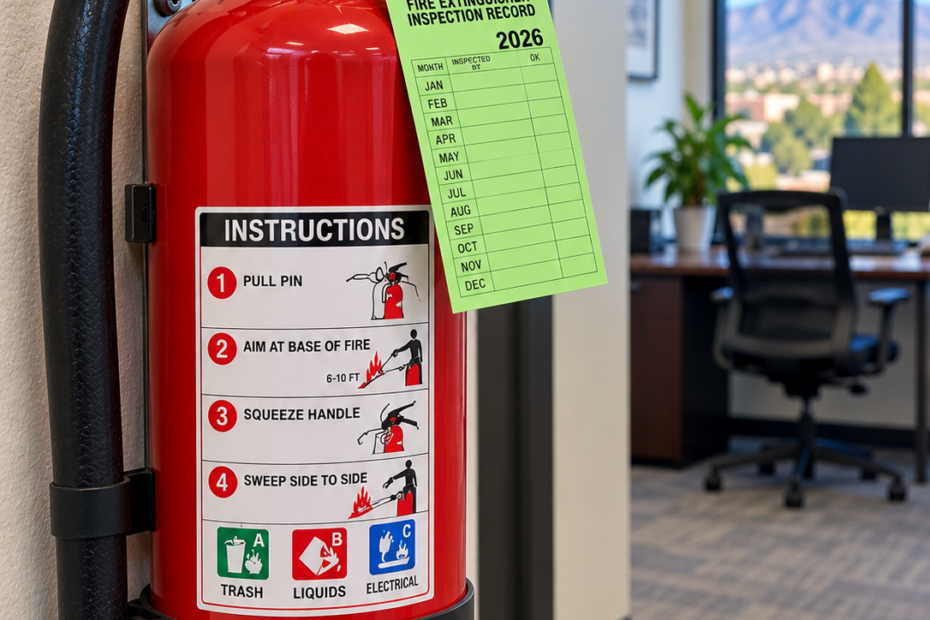
In New Mexico, commercial fire extinguisher servicing and tagging generally must be performed by someone holding the appropriate state-issued certificate of fitness for portable fire extinguishers. A business owner, employee, maintenance worker, or general handyman cannot simply attach an annual service tag unless they meet the applicable state requirements.
The distinction matters because checking an extinguisher’s condition is not the same as performing professional maintenance. New Mexico businesses are responsible for keeping their extinguishers ready for use, but certain services require properly credentialed personnel.
Under 10.25.2 NMAC, New Mexico regulates individuals performing fire protection equipment work, including inspection, maintenance, servicing, tagging, and repair. The rules identify portable fire extinguishers as a specific area of authorization.
For restaurant owners, property managers, office administrators, and other business operators, the practical question is whether the person servicing the extinguisher has the credentials required for that particular work.
What Does New Mexico Law Require for Fire Extinguisher Servicing?
New Mexico’s fire protection equipment rules establish a certificate-of-fitness framework for people performing regulated fire protection work.
Under 10.25.2.8 NMAC, the state addresses certificate requirements for individuals who install, inspect, maintain, service, tag, or repair covered fire protection equipment.
Portable fire extinguishers are identified as a separate discipline within the regulatory framework.
This means a technician’s authorization should match the equipment being serviced. Experience with another fire protection system does not automatically establish authorization to perform portable extinguisher work.
A certificate of fitness is also different from an ordinary business license. A company may be registered to operate in New Mexico without every employee being authorized to perform regulated extinguisher servicing.
What Is a New Mexico Certificate of Fitness?
A certificate of fitness is a state-issued credential associated with an individual’s qualifications to perform specified fire protection equipment work.
For portable fire extinguishers, the credential helps establish whether the technician is authorized under the applicable New Mexico rules.
It is not a general authorization to service every type of fire protection system.
For example, qualifications involving commercial kitchen hood suppression systems should not automatically be treated as proof of authorization to inspect or recharge portable extinguishers.
New Mexico’s certificate requirements also address the individual nature of the credential. A technician cannot simply rely on another person’s certificate as permission to perform regulated work.
Businesses can consult the New Mexico State Fire Marshal’s certificate-of-fitness information for application and credential guidance.
Does the Fire Extinguisher Service Company Also Need Proper Authorization?
Businesses should verify both the service provider’s company information and the credentials of the individual performing the work.
The important distinction is that a company’s commercial registration, advertising, or general fire protection experience does not substitute for the appropriate technician authorization.
Additional registration, licensing, or operational requirements may apply depending on the services performed.
Before hiring a vendor, ask who will perform the work and whether that person holds the current certificate appropriate for portable fire extinguishers.
Can a Business Owner or Employee Inspect Fire Extinguishers?
Yes, employees can perform routine visual checks as part of a workplace’s fire extinguisher safety program. However, those checks should not be confused with professional annual maintenance, recharging, or regulated service tagging.
For many workplaces, OSHA’s portable fire extinguisher standard, 29 CFR 1910.157, requires employers to visually inspect portable extinguishers monthly and ensure they receive annual maintenance checks, subject to the standard’s applicability and exceptions.
A routine visual check generally looks for obvious problems, including whether an extinguisher is accessible, in its designated location, and free from visible damage.
Employees may also check whether the pressure indicator is in the proper operating range when the extinguisher has a gauge.
These checks help businesses identify problems between professional service visits.
What Is the Difference Between a Monthly Check and Annual Maintenance?
Activity | What it involves | Who should perform it? |
Routine monthly visual check | Looking for missing, obstructed, damaged, or apparently discharged extinguishers | A designated employee or responsible person following applicable workplace procedures |
Annual maintenance and service tagging | Required maintenance examination, service documentation, and applicable tag updates | Personnel with the appropriate New Mexico authorization |
Recharging | Restoring a rechargeable extinguisher after discharge or when otherwise required | Properly authorized and equipped service personnel |
Internal maintenance | Internal examination and related procedures when required for the extinguisher type | Qualified, appropriately authorized service personnel |
Hydrostatic testing | Pressure testing at applicable intervals using prescribed procedures and equipment | Personnel and facilities meeting applicable testing and authorization requirements |
The schedule and procedures depend on the extinguisher type, its condition, the applicable standards, and manufacturer instructions.
A monthly visual check does not extend an annual maintenance interval. Similarly, a current annual tag does not eliminate the need to check the extinguisher regularly.
Who Is Allowed to Attach an Annual Fire Extinguisher Service Tag?
A professional annual service tag should be attached or updated as part of maintenance performed by personnel authorized to conduct that work under New Mexico’s fire protection equipment rules.
An annual tag is not merely a sticker showing that someone looked at the extinguisher.
It serves as documentation associated with a maintenance activity and should accurately reflect the service performed.
A person who has not completed the required work should not attach a tag suggesting that the extinguisher has received professional maintenance.
What Information Should an Extinguisher Service Tag Show?
Depending on the applicable standard and service activity, extinguisher tags or labels may identify the servicing organization, the date of maintenance, and other required service information.
Some maintenance and testing activities require separate labels, collars, or records rather than relying on the annual tag alone.
A facility manager should be able to connect the tag to an actual service visit and the work completed.
If a tag is missing, illegible, questionable, or inconsistent with the business’s records, the appropriate response is to investigate the service history.
A tag is evidence of documented service, not proof that an extinguisher will remain functional regardless of its condition.
An extinguisher can develop damage, lose pressure, or become obstructed after a professional inspection.
How Can You Verify a Fire Extinguisher Service Provider in New Mexico?
Before hiring a company to inspect or tag extinguishers, ask for enough information to confirm that the work will be performed by properly authorized personnel.
The following five checks provide a practical starting point.
- Ask about the technician’s certificate of fitness. Confirm that the individual performing regulated work holds the applicable New Mexico credential.
- Verify the portable fire extinguisher discipline. Do not assume authorization for sprinkler systems, hood suppression systems, or another discipline covers portable extinguishers.
- Check whether the credential is current. Request current credential information and confirm its standing with the appropriate state authority when necessary.
- Confirm the services the provider can perform. Annual maintenance, recharging, internal examinations, and hydrostatic testing may involve different equipment, procedures, and qualifications.
- Ask what documentation you will receive. A service provider should be able to explain the tags, labels, maintenance records, and any deficiencies identified.
This process is especially useful when comparing vendors or reviewing an unfamiliar company’s proposal.
A low service price or a promise to tag every extinguisher quickly should not replace credential verification.
Does an NFPA Certification Replace a New Mexico Certificate of Fitness?
Not automatically.
Training or professional credentials related to National Fire Protection Association standards may demonstrate knowledge, but they are not necessarily interchangeable with a state-issued certificate of fitness.
NFPA 10, the standard for portable fire extinguishers, provides technical requirements for extinguisher selection, installation, inspection, maintenance, recharging, and testing.
New Mexico’s regulatory requirements determine who may perform regulated work within the state. Applicable adopted codes, local requirements, and manufacturer instructions also matter.
Businesses should verify state authorization rather than relying solely on a vendor’s statement that its technicians are “NFPA trained.”
What Happens if Your Fire Extinguisher Tag Is Expired?
An overdue annual maintenance tag is a reason to review the extinguisher’s service status and arrange the necessary maintenance.
It does not mean the business should simply purchase a replacement tag or change the date.
The responsible person should review the extinguisher’s condition and records, then contact an appropriately authorized service provider to determine what work is needed.
If an extinguisher is damaged, has been discharged, or is otherwise unsuitable for service, it should be addressed promptly. The business may need a suitable replacement while the unit is removed for maintenance.
The exact response depends on the condition of the equipment and the fire protection requirements for the occupancy.
Example: A Santa Fe Restaurant with an Expired Tag
Consider a restaurant manager conducting a routine check before opening.
The manager notices that a portable extinguisher near the kitchen has an overdue annual maintenance tag. Its pressure gauge also indicates a condition outside the acceptable range.
The manager should not assume that replacing the tag will resolve the problem.
Instead, the extinguisher’s condition needs professional attention. An authorized service provider can determine whether the unit can be serviced or requires replacement.
If the extinguisher must be removed, the restaurant should address the resulting protection gap.
Restaurants may have multiple fire protection requirements. A Class K extinguisher used for commercial cooking hazards is distinct from the kitchen hood fire suppression system, and one does not automatically eliminate the need for the other.
For businesses reviewing both types of protection, Brazas Fire also provides commercial kitchen hood fire suppression services.
Example: An Albuquerque Office with a Current Fire Extinguisher Tag but Visible Damage
Now consider an office extinguisher that received annual maintenance three months ago.
Its tag appears current, but an employee discovers damage to the hose and signs that the unit has been struck.
The current tag does not make the damage acceptable.
The business should have the extinguisher evaluated and address the need for replacement protection if the unit must be removed from service.
These examples illustrate why routine checks and professional maintenance serve different purposes.
Do All Fire Extinguishers Require the Same Service?
No. Fire extinguisher maintenance requirements vary according to the equipment’s type, construction, condition, and applicable standards.
A common multipurpose ABC dry chemical extinguisher is not maintained in exactly the same way as a carbon dioxide or Class K wet chemical extinguisher.
Some units are rechargeable, while others are nonrechargeable and must be replaced after use or when required by their condition or instructions.
Certain stored-pressure dry chemical extinguishers are subject to six-year internal maintenance requirements, while hydrostatic testing intervals depend on the extinguisher category.
These longer-term requirements are separate from annual maintenance.
The applicable edition of NFPA 10, OSHA requirements where relevant, manufacturer instructions, and local enforcement requirements should be considered together.
For businesses with several extinguisher types, a useful service record identifies each unit individually rather than treating the entire inventory as interchangeable.
What About Local Fire Marshal Requirements in Albuquerque and Santa Fe?
New Mexico’s statewide certificate-of-fitness requirements are an important starting point, but local enforcement also matters.
The authority having jurisdiction (AHJ) is the organization or official responsible for enforcing applicable fire protection requirements in a particular setting.
Depending on the location and occupancy, that may involve a municipal fire prevention office, the State Fire Marshal, or another authorized agency.
Local authorities may have requirements concerning documentation, equipment placement, inspection records, and correction of identified deficiencies.
A business should not assume that a provider’s general claim of being “fire marshal approved” establishes compliance with every requirement.
If there is uncertainty about a particular extinguisher, occupancy, or service practice, ask the appropriate authority for clarification.
Frequently Asked Questions
Can a Handyman Legally Tag Fire Extinguishers in New Mexico?
Not merely because the person performs general maintenance. Regulated extinguisher servicing and tagging require the applicable New Mexico authorization. A handyman who independently holds the required credentials would need to act within the scope of that authorization.
Can an Employee Sign the Monthly Fire Extinguisher Inspection Record?
A designated employee may document routine visual checks when permitted under the applicable workplace procedures and standards. That record should not be represented as professional annual maintenance or a regulated service tag.
Is an Annual Fire Extinguisher Inspection Required in New Mexico?
Commercial extinguishers are generally subject to periodic inspection and maintenance requirements under applicable fire codes and workplace safety rules. For workplaces covered by OSHA’s 29 CFR 1910.157 maintenance provisions, employers must ensure annual maintenance checks. Specific obligations depend on the occupancy, equipment, and governing requirements.
Can a Fire Extinguisher Be Recharged Without a New Service Tag?
Recharging requires proper service procedures and documentation. The necessary tags, labels, and records depend on the applicable requirements and work performed. Simply refilling a cylinder without following those requirements is not an acceptable substitute for professional service.
How Do I Know Whether a Fire Extinguisher Technician Is Licensed?
Ask for the technician’s current New Mexico certificate-of-fitness information, confirm that it covers portable fire extinguishers, and verify the credential with the issuing authority when necessary.
Commercial Fire Extinguisher Service in Albuquerque and New Mexico
Proper extinguisher maintenance involves more than keeping a current tag attached to a cylinder. Business owners need to know that their equipment has been examined, serviced, and documented by personnel authorized to perform the work.
Brazas Fire provides commercial fire extinguisher sales, inspections, annual maintenance, recharging, and related fire protection services for businesses in Albuquerque, Santa Fe, Rio Rancho, and other New Mexico communities.
Businesses looking for professional service can learn more about Brazas Fire’s fire extinguisher inspection and maintenance services.
For additional guidance on scheduling commercial extinguisher service, read Where Can I Get Commercial Fire Extinguishers Serviced and Tagged in Albuquerque?.
Contact Brazas Fire at 505-889-8999 or visit brazasfire.com to discuss your facility’s extinguisher service needs.
A properly maintained extinguisher should be ready for an emergency, not merely appear current on paper. Choosing a qualified service provider and maintaining accurate records are essential parts of responsible commercial fire protection.